
Short answer: the Pokémon Trading Card Game first went on sale in Japan on October 20, 1996, published by Media Factory. The English version came out in the United States on January 9, 1999, published by Wizards of the Coast, starting with the 102-card Base Set. Everything collectors argue about today, from 1st Edition stamps to shadowless borders to what a WOTC card is, comes from those first seven years.
This is the long version. It covers who made the first cards, what came out when, why the English cards look the way they do, and how the game changed hands in 2003. Where a detail is disputed or we couldn't verify it, we say so rather than guess. Sources are at the bottom.
Did Pokémon cards come out in 1995?
No. The Pokémon games themselves came out in Japan in February 1996 (Pokémon Red and Green for the Game Boy), and the first Pokémon cards followed later that year. If you have a card that says 1995 on it, that date is a copyright line for the Pokémon property, not the year the card was printed. Unlimited Base Set cards carry the line “1995, 96, 98 Nintendo, Creatures, GAMEFREAK” (1st Edition and shadowless printings add “99”), because the underlying franchise dates to 1995, the games to 1996, and the Wizards of the Coast production to 1998.
Who made the first Pokémon cards?
Two different answers, depending on what you mean by “Pokémon card.”
- The first collectible Pokémon cards were Bandai's Carddass series, released in Japan in September 1996. These were collectible cards, not a playable game.
- The first Pokémon trading card game was developed by Creatures Inc. and published in Japan by Media Factory on October 20, 1996. The initial release was sold as a starter deck and a first expansion pack; collectors now call it the Japanese Base Set. This is the game that everything since descends from.
One source we checked lists the Japanese launch as October 18 rather than October 20. Wikipedia, Bulbapedia, and most collector references use the 20th, so that's the date we use here.
1996 to 1998: the Japanese years
For a little over two years the card game existed only in Japanese. Media Factory published it, and the early Japanese expansions established the mechanics that still define the game: Energy cards, evolution stages, weakness and resistance, and the prize-card win condition. Japanese cards from this window have no set symbols, no 1st Edition stamps, and none of the print-run quirks that make the English cards so complicated to collect. They're simpler, and to many collectors, they're the true originals.
Media Factory kept publishing the Japanese game until late 2000, when The Pokémon Company took over publishing in Japan, starting with the Awakening Legends expansion.
When did Pokémon cards come out in English?
January 9, 1999. Wizards of the Coast, the Seattle-area company behind Magic: The Gathering, licensed the game for North America and launched it with Base Set: 102 cards, sold in booster packs, theme decks, and starter sets. Wizards had actually printed a small demo pack in 1998 ahead of the launch, which is why you'll see 1998 on the copyright line of early English cards.
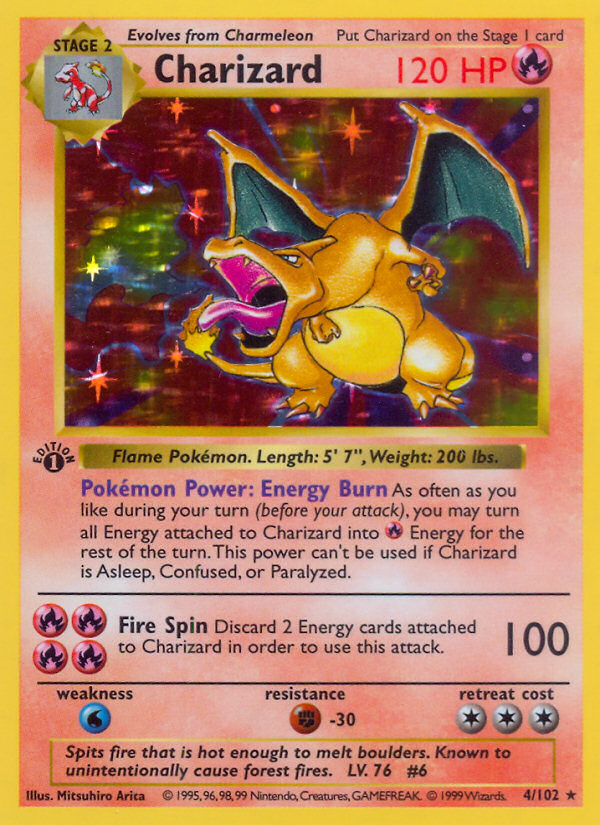
Base Set Charizard 4/102 from the first English print run, January 1999. The Edition 1 stamp sits below the artwork on the left.
Base Set is where most of the collector vocabulary comes from:
- 1st Edition. The first print run carried a small “Edition 1” stamp on the left side of the card. Later print runs dropped it. How to read the 1st Edition stamp.
- Shadowless. The earliest English Base Set cards were printed with no drop shadow on the right edge of the art box. Wizards changed the template in the second print run, adding the shadow and adjusting the layout. Shadowless cards exist only for English Base Set. What a shadowless card looks like.
- Unlimited. Everything after that: shadowed, no 1st Edition stamp, printed in large quantities through 1999 and 2000.
- Holo. The rare cards in each pack had holographic foil in the art box. Holo vs reverse holo, explained.
1999 to 2003: the Wizards of the Coast era
Collectors call these the WOTC cards, and they are the core of the vintage market. Wizards published the English game from Base Set through Skyridge, then lost the license in 2003. Hasbro bought Wizards of the Coast in September 1999 for $325 million, a purchase widely credited to the strength of the Pokémon license.
The English expansions in release order:
| Expansion | Released | Notes |
|---|---|---|
| Base Set | January 9, 1999 | 102 cards. 1st Edition, shadowless, and unlimited printings. Full card list. |
| Jungle | June 16, 1999 | First expansion. Read more. |
| Fossil | October 10, 1999 | Read more. |
| Base Set 2 | February 24, 2000 | English-only reprint compilation of Base Set and Jungle. |
| Team Rocket | April 24, 2000 | Introduced Dark Pokémon. Read more. |
| Gym Heroes | August 14, 2000 | Read more. |
| Gym Challenge | October 16, 2000 | Second of the two Gym sets. |
| Neo Genesis | December 16, 2000 | First Generation II Pokémon. The Neo era. |
| Neo Discovery | June 1, 2001 | |
| Neo Revelation | September 21, 2001 | |
| Neo Destiny | February 28, 2002 | |
| Legendary Collection | May 24, 2002 | Reprint set. |
| Expedition Base Set | September 15, 2002 | First e-Card set. |
| Aquapolis | January 15, 2003 | |
| Skyridge | May 12, 2003 | Last set published by Wizards of the Coast. |
Alongside the expansions, Wizards distributed Black Star Promos from July 1999 to March 2003 through movies, magazines, events, and product tie-ins. How the Black Star Promos worked.
What is the oldest Pokémon card?
If you mean the oldest card from the trading card game, it's anything from the Japanese Base Set of October 1996. If you mean the oldest Pokémon card of any kind, the Bandai Carddass cards from September 1996 predate the game by about a month. Claims of earlier Pokémon cards from 1995 circulate online, but we couldn't verify them against a reliable source, so we don't repeat them. For the English game, nothing is older than 1st Edition shadowless Base Set from January 1999.
2003 onward: The Pokémon Company takes over
In July 2003 the English game moved from Wizards of the Coast to Pokémon USA (now The Pokémon Company International), with Nintendo of America handling distribution until 2006. The first set under the new arrangement was EX Ruby & Sapphire, released in July 2003. Every English set since has been published by The Pokémon Company, and by the end of 2025 there were well over a hundred English sets in total.
The eras since then each have their own collecting logic. A few we've written about:
- Diamond & Pearl and Platinum (2007 to 2009), the LV.X era.
- Hidden Fates, Champion's Path, and Crown Zenith, and why special sets have no booster boxes.
- Vivid Voltage and the Amazing Rares, from the 2020 boom.
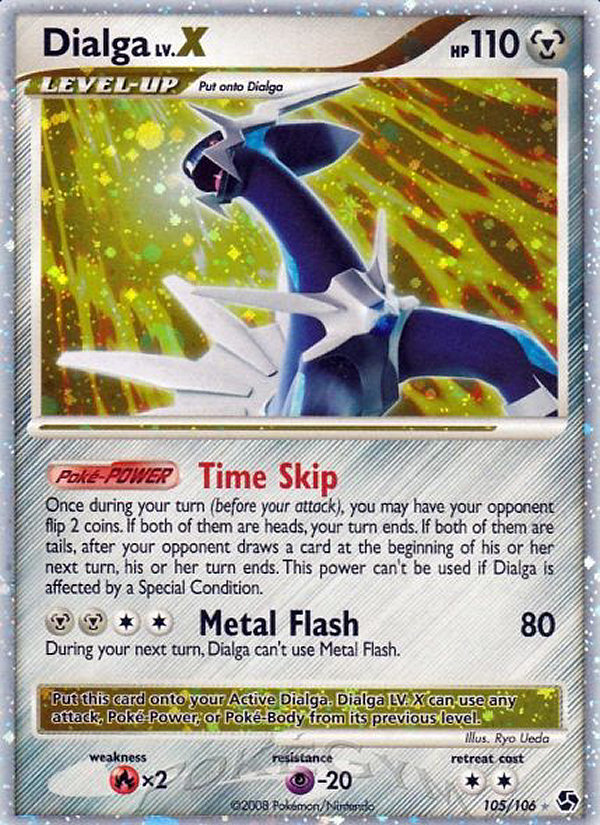
Dialga LV.X from Great Encounters (2008), one of the level-up cards that defined the Diamond & Pearl era under The Pokémon Company.
The game's digital side has changed hands too: Pokémon TCG Online closed in 2023 and was replaced by Pokémon TCG Live and, in 2024, the mobile app Pokémon TCG Pocket.
Are 1999 Pokémon cards worth anything?
Some are worth a lot and most are worth very little, and the difference comes down to four things: which card, which printing, holo or not, and condition.
- Which card. Charizard, Blastoise, Venusaur, and a handful of others carry the market. Common Pokémon and Trainer cards from 1999 are mostly worth less than a coffee.
- Which printing. 1st Edition and shadowless printings of Base Set command far more than unlimited copies of the same card.
- Holo or not. A holographic rare is a different product from the same Pokémon as a non-holo.
- Condition. Professional grading on PSA's 1 to 10 scale is what separates a worn playground card from a collectible. A high grade can multiply the price many times over.
We don't quote prices in this post because they move constantly. If you want to see what graded vintage cards actually trade at, browse our graded card collection, where every card is listed with its grade and set.
Where to go next
- Vintage Pokémon cards, era by era: the collector's overview.
- 1st Edition Pokémon cards: what the stamp means and how to spot one.
- Shadowless Pokémon cards: how to tell them from unlimited.
- Holo vs reverse holo: how to read the foil.
- Wizards Black Star Promos: the cards that came outside the pack.
- Team Rocket and the Dark Pokémon.
- Pokémon Base Set card list: all 102 cards, rarities, and printings.
- Coming next in this series: how PSA grading works and what it costs, and a guide to Pokémon card rarity symbols.
Sources
- Wikipedia, Pokémon Trading Card Game (publisher dates, Hasbro acquisition, digital clients).
- Wikipedia, Base Set (Pokémon) (October 20, 1996 and January 9, 1999 release dates, 1998 demo pack).
- Wikipedia, List of Pokémon Trading Card Game sets (set count, Base Set 2 as English-only).
- Bulbapedia, Pokémon Trading Card Game (Media Factory, Bandai Carddass, Awakening Legends handover).
- Bulbapedia, List of Pokémon Trading Card Game expansions (Wizards to Pokémon USA transition, Nintendo distribution to 2006).
- Beckett, Pokémon TCG Expansion Set and Release Date List (Wizards-era release dates).
- Wargamer, All Pokémon sets in order of release (Wizards Black Star Promos date range).
- Poké Master Center, The Ultimate Pokémon 1999 WotC Base Set Guide (102 cards, shadowless template change).
- Bulbapedia, Base Set 2 (130-card reprint of Base Set and Jungle).
- WikiDex, Base Set (TCG) (copyright lines by printing).
The sabi journal
Stories behind the things we carry