
Fossil came out on October 10, 1999, a month before Pokémon: The First Movie opened in theaters and Burger King started packing Poké Balls into kids' meals. It was the third English set, and it brought Articuno, Moltres, Gengar, Dragonite, and Lapras into the English card game. It was also the last set printed with the original holo pattern. Here is what was in the set, what came in a Fossil booster pack, and what the fall of 1999 looked like.
What was the Pokémon Fossil set?
The English Fossil set has 62 cards: 15 holo rares, 15 non-holo rares, 15 uncommons, and 17 commons. As in Jungle, the non-holo rares are second printings of the holos, so cards 1 through 15 appear again as cards 16 through 30 without the foil. The set is based on the Japanese Mystery of the Fossils, a 48-card expansion from June 1997. PSA notes that Wizards originally planned the English release for around January 2000 and moved it up to October.
The 15 holos are Aerodactyl, Articuno, Ditto, Dragonite, Gengar, Haunter, Hitmonlee, Hypno, Kabutops, Lapras, Magneton, Moltres, Muk, Raichu, and Zapdos. In its guide to the set, PSA called Dragonite "probably the standout card" and the three birds "very desirable."
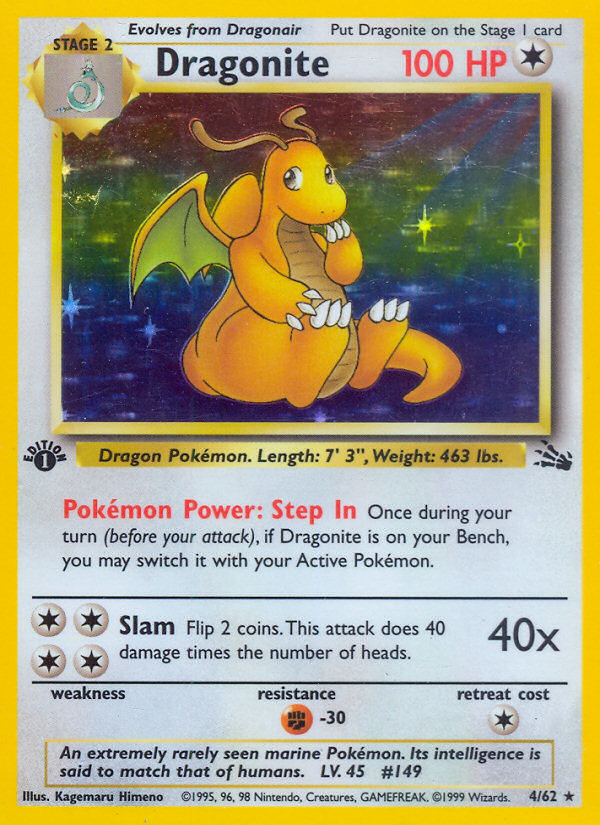
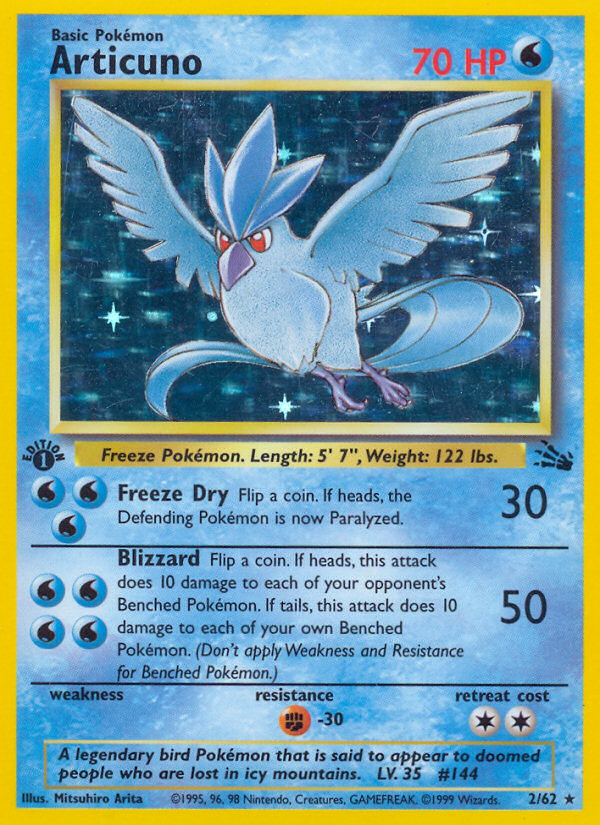
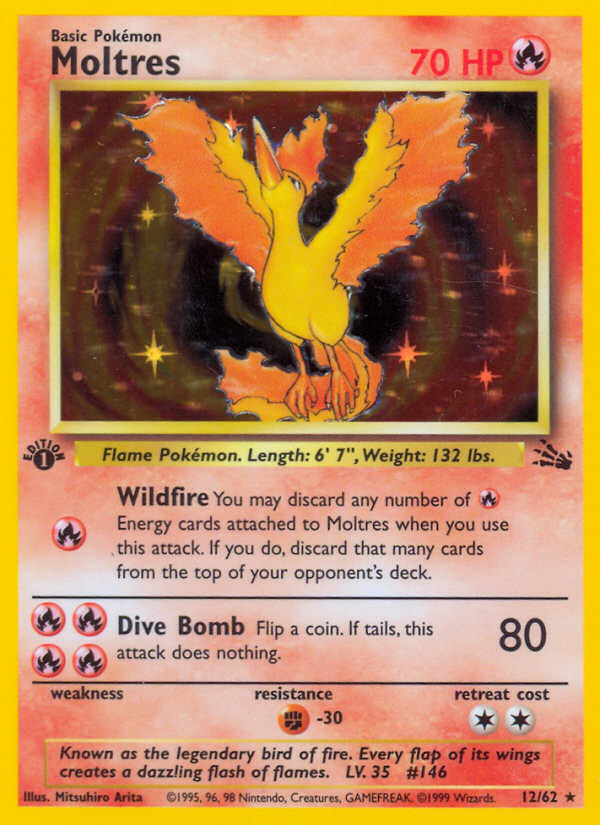
Dragonite 4/62 with two of Fossil's legendary birds, Articuno 2/62 and Moltres 12/62.
Fossil was also the last expansion printed with Starlight holofoil, the pattern of small scattered stars used on the earliest English holos. The Base Set 2 reprint set that followed moved to the Cosmos pattern, with larger dots and circles.
What came in a Fossil booster pack
A Fossil booster pack had the same structure as Jungle: 11 cards, with seven commons, three uncommons, and one rare, and a holo in roughly one pack out of three. Boxes held 36 packs, and the packs came in three wrapper designs featuring Aerodactyl, Zapdos, and Lapras.
Two 60-card theme decks launched alongside it. BodyGuard mixed Grass and Fighting Pokémon around a holo Muk, and LockDown mixed Fire and Water around a holo Lapras. Both came with a brown Aerodactyl coin.
As of September 2026, PriceCharting tracked a sealed 1st Edition Fossil pack at about $460 and an Unlimited pack at about $300. Sealed boxes show how far the market has come. In 2017, PSA estimated that 1st Edition Fossil boxes sold for $900 to $1,000. Recent 1st Edition box sales have run from about $13,600 to $35,000, and two Unlimited boxes sold at Heritage Auctions for $16,250 and $18,750 in the summer of 2026.
Fossil's print errors
Fossil has more well-known errors than most vintage sets, and collectors search for them by name. The best known is the Zapdos holo, whose foil has a cut-out for an evolution box the card doesn't have. It appears on all 1st Edition and most Unlimited copies, and PSA grades both the error and the corrected version. The Haunter holo has a blue ink stain, and the Hitmonlee holo has yellow-orange streaks that collectors call "Stainmonlee." The Krabby card has a set symbol that looks slashed, and a few Gengar holos have a yellow ink mark on the back.

Zapdos 15/62, the holo behind Fossil's best-known foil error.
Aerodactyl, card number one
Aerodactyl 1/62 opens the set. Kagemaru Himeno illustrated it, and it evolves from the Mysterious Fossil Trainer card. Its Pokémon Power, Prehistoric Power, stops every player from playing Evolution cards while it is in play. In Japanese the power is called Ancient Power, the name of a move that didn't exist in the video games until the next generation. Aerodactyl is also on one of the three pack wrappers and on the coin in both theme decks, and PSA points out that the set symbol itself resembles Aerodactyl's skeletal hand.
Like Jungle's Clefable, Aerodactyl was one of only four Wizards-era cards printed with a Prerelease stamp. On the regular 1st Edition holo, PSA's population report lists 5,325 graded copies, including 1,535 PSA 9s and 204 PSA 10s at the time of writing.

PSA 9 · Fossil, 1999
Aerodactyl 1/62, 1st Edition Holo
Kagemaru Himeno's Aerodactyl from the 1st Edition run, in the Starlight holo that ended with this set. PSA 9 Mint. Cert 43981927.
$400.00 View card
Fall 1999: the movie, Burger King, and the bans
Fossil landed in the busiest season Pokémon had in America. Pokémon Yellow arrived in mid-October and sold a million copies in about ten days. On November 10, Warner Bros. released Pokémon: The First Movie, which opened to $31 million over its first weekend and went on to earn $85.7 million in North America. Theaters handed out four promo cards, Electabuzz, Mewtwo, Pikachu, and Dragonite, each with a gold stamp reading "Kids WB Presents," and TIME reported that Warner ran out of cards for ticket buyers.
Burger King ran its Pokémon promotion from November 8 to December 31, with 57 toys packed in plastic Poké Ball containers. From November 15, customers could add one of six 23-karat gold-plated cards to a meal for $1.99: Charizard, Jigglypuff, Mewtwo, Pikachu, Poliwhirl, or Togepi. The promotion ended with a recall: on December 27, Burger King and the Consumer Product Safety Commission recalled more than 25 million of the ball-shaped containers as a suffocation hazard for small children.
TIME's November 22 issue ran a story called "Beware of the Poke Mania," covering school card bans and a lawsuit in which New Jersey parents accused the card maker of making rare cards scarce on purpose. On television, the anime's Indigo Plateau Conference arc ended on November 27. Beanie Babies, the other great collectible of the decade, had been given an end date of December 31, 1999, and store owners told CBS that Pokémon was taking their place. By the time Gym Heroes arrived the next summer, the cards were a fixture.
Collecting Fossil today
In PSA 10, the 1st Edition holos of Gengar, Dragonite, Lapras, and Articuno sit at the top of the set. PSA's own sales data shows a 1st Edition Dragonite PSA 10 selling for $6,964 in June 2026, and its most recent 1st Edition Gengar PSA 10 sale was $6,460. Beyond the full set, collectors build Fossil around the three legendary birds, the 1st Edition holos, the print errors, or sealed packs in all three wrapper designs.
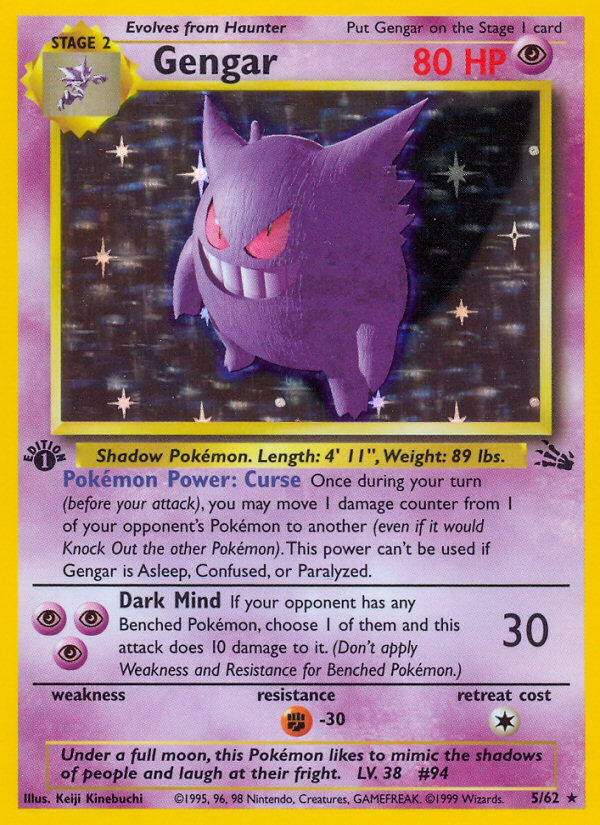
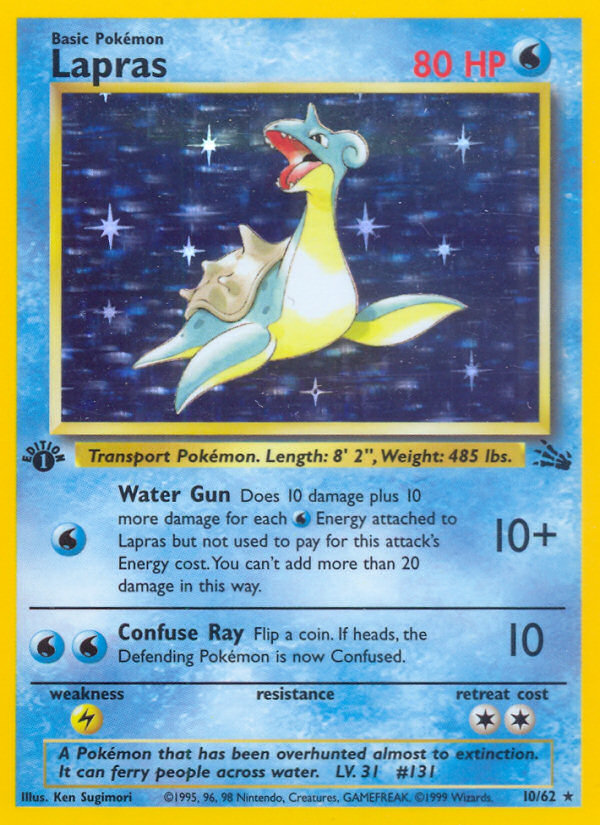
Gengar 5/62 and Lapras 10/62, two of the holos at the top of the set in PSA 10.
If you are new to vintage cards, start with the basics: how to read a 1st Edition stamp and how Fossil fits after Jungle, the set that came four months before it.
Keep reading
- Vintage Pokémon cards, era by era: a collector's guide
- Pokémon Jungle (1999): packs, Pikachu, and the No Symbol holos
- Team Rocket's Dark Pokémon, from Rocket Gang to Team Rocket Returns
- Wizards Black Star Promos, 1999 to 2003
Browse the graded and ungraded Pokémon cards we carry in Artifacts.
Frequently asked questions
When did the Pokémon Fossil set come out? Fossil was released in English on October 10, 1999. It was the third English set, after Base Set and Jungle.
What are the most valuable Pokémon Fossil cards? In PSA 10, the 1st Edition holos of Gengar, Dragonite, Lapras, and Articuno lead the set. PSA recorded a 1st Edition Dragonite PSA 10 sale of $6,964 in June 2026, and its most recent 1st Edition Gengar PSA 10 sale was $6,460.
What is in a Fossil booster pack? Eleven cards: seven commons, three uncommons, and one rare, with a holo rare in roughly one pack in three. Boxes held 36 packs in Aerodactyl, Zapdos, and Lapras wrapper designs.
Why does the Fossil Zapdos holo have an error? The holo foil has a cut-out for an evolution box, even though Zapdos is a Basic Pokémon and has none. The error is on all 1st Edition copies and most Unlimited copies, and PSA grades both versions.
How much is a sealed Fossil booster pack worth? As of September 2026, PriceCharting tracked sealed 1st Edition Fossil packs at about $460 and Unlimited packs at about $300.
The sabi journal
Stories behind the things we carry