
Pokémon cards have been printed in English since January 1999, and in that time the game has gone through several distinct eras, each with its own sets, printing quirks, and chase cards. This guide walks through them in order and links to our deeper guides on each, so you can place an old Pokémon card in its era and know what to look for.
If you want the dates behind all of this, from the 1996 Japanese launch to the 2003 handover, start with When did Pokémon cards come out? The history of the Pokémon TCG, then come back here for the era-by-era view.
What counts as a vintage Pokémon card?
There is no official definition, but among collectors, vintage most often means the Wizards of the Coast era, from Base Set in 1999 to Skyridge in 2003, and many stretch it to cover the EX sets that followed. In clothing, the usual rule is 20 years, as we explain in What Is Vintage Clothing?, and by that measure every card printed before the mid-2000s qualifies.
The Wizards of the Coast era, 1999 to 2003
Wizards of the Coast published the English card game from its launch until 2003. Base Set arrived in January 1999, and its earliest prints were made without the drop shadow beside the artwork, which is why collectors pay more for shadowless cards. Jungle followed in June, with the No Symbol holos and the Jungle Pikachu, and Fossil arrived in October, a month before the first movie. Most Wizards sets were printed first in a smaller run marked with a 1st Edition stamp.
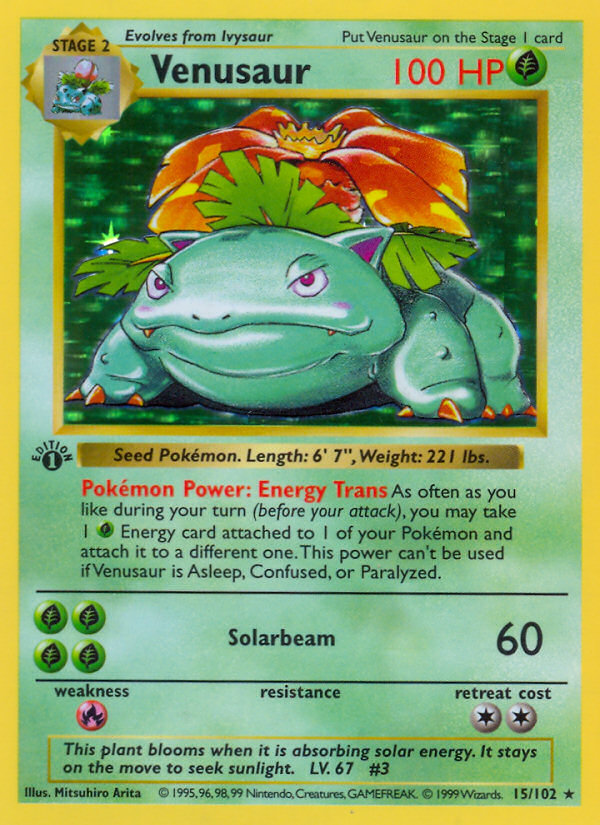
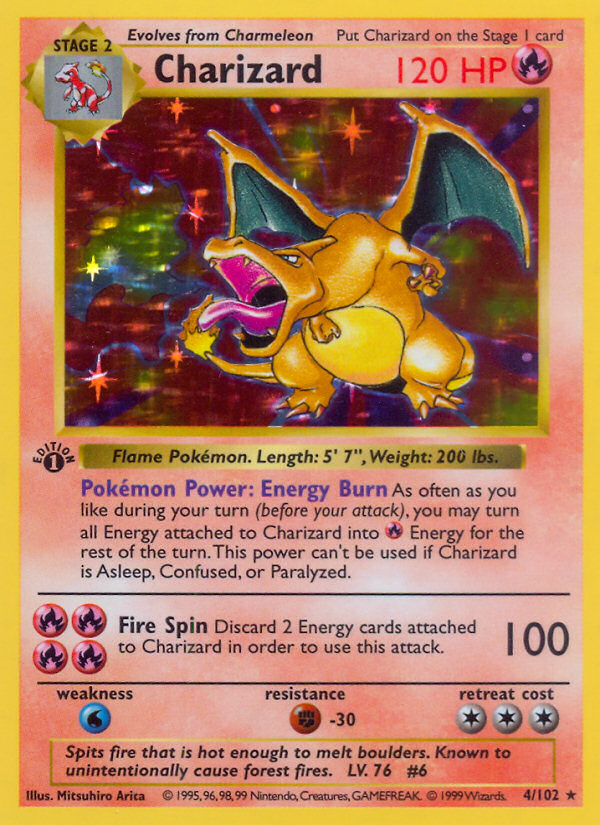
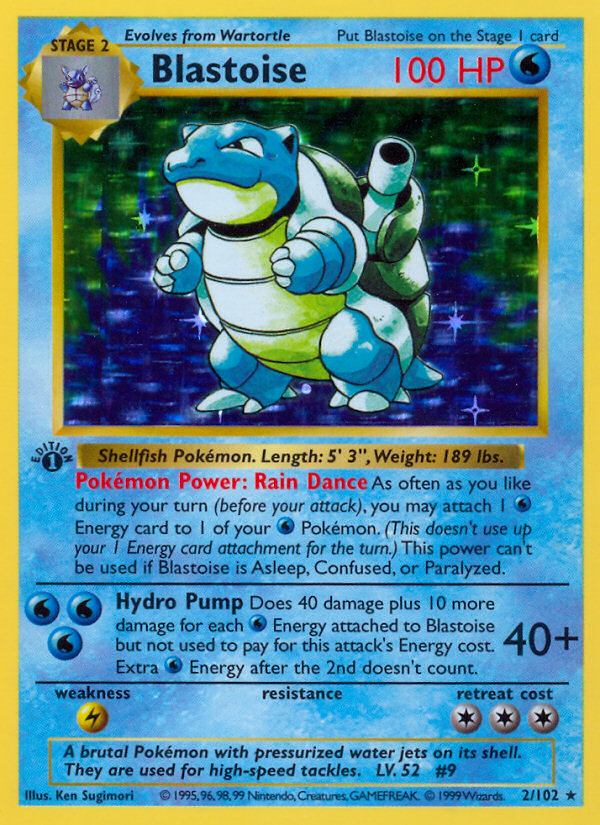
The three Base Set starters: Venusaur 15/102, Charizard 4/102, and Blastoise 2/102.
Team Rocket, released in April 2000, introduced Dark Pokémon, and Gym Heroes and Gym Challenge put Kanto's Gym Leaders on the cards later that year. The four Neo sets, released between December 2000 and February 2002, brought in the second generation of Pokémon and the first Shining Pokémon, and Neo Destiny was the last English set with a 1st Edition stamp. Alongside the sets, Wizards gave out 53 numbered Black Star Promos at movie theaters, in magazines, and through the Pokémon League.
The last Wizards years put reverse holos into booster packs with Legendary Collection in 2002, then launched the e-Reader sets with Expedition. Skyridge, released in May 2003, was the final Wizards set, and the company's license ended that September.
The EX era, 2003 to 2007
Starting with EX Ruby & Sapphire in June 2003, the card game came out under Nintendo and later Pokémon USA. The EX sets have their own well-known oddities. EX Team Rocket Returns, released in 2004, revived Dark Pokémon, added Rocket's Pokémon-ex, and introduced the Gold Star rarity with the three Hoenn starters, all covered in our guide to Team Rocket and Dark Pokémon cards.
Diamond & Pearl and Platinum, 2007 to 2009
The Sinnoh-era sets printed a level on every Pokémon and introduced LV.X cards, which were played on top of a Pokémon with the same name. Eleven English sets ran from Diamond & Pearl in February 2007 to Arceus in November 2009, and Mitsuhiro Arita, the illustrator behind the Base Set Charizard, drew some of their best-loved cards. Our guide to the Diamond & Pearl era covers the sets, the packs, and the mechanics.
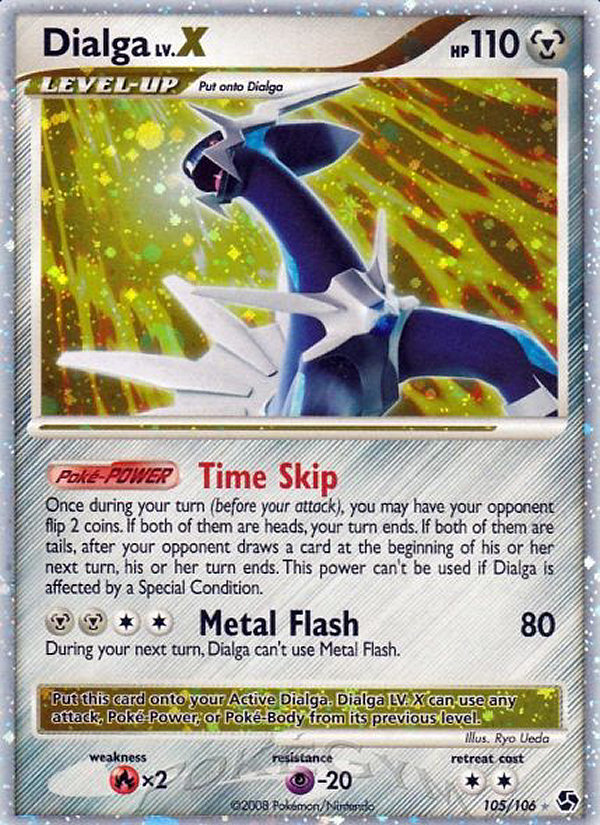
Dialga LV.X from Great Encounters, one of the LV.X cards that defined the Diamond & Pearl era.
The modern era and special sets
The HeartGold & SoulSilver series took over in February 2010, followed by the Black & White, XY, Sun & Moon, Sword & Shield, and Scarlet & Violet eras. Recent years added a new kind of release, the special set. Hidden Fates in 2019, Champion's Path in 2020, and Crown Zenith in 2023 were sold only in Elite Trainer Boxes, tins, and collections, never in booster boxes. Vivid Voltage, released in November 2020, arrived in the middle of the pandemic card boom and brought Amazing Rares to English.
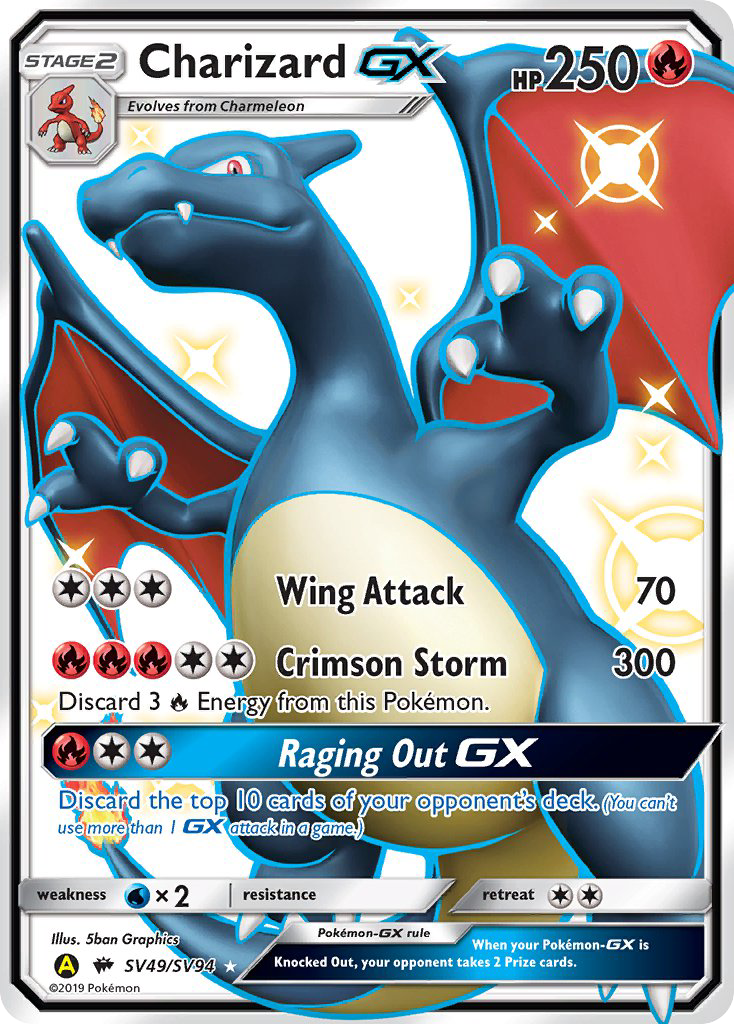
The Shiny Vault Charizard-GX from Hidden Fates, the chase card of the 2019 special set.
How to read an old Pokémon card
Three details tell you most of what you need. Look below the artwork on the left for a 1st Edition stamp. On Base Set cards, check the right edge of the artwork box for a drop shadow. Then tilt the card under a lamp to see whether the foil sits in the artwork, across the rest of the card, or nowhere at all, as we explain in our guide to holo and reverse holo cards.
After that, the set symbol, the card number, and the condition do the rest. Early Japanese cards follow different rules, with no collector numbers and no 1st Edition stamp before 2001, which we cover in our guide to Team Rocket and the Japanese Rocket Gang set.
Ways to collect
Some collectors build one set at a time, in 1st Edition or Unlimited. Others follow an illustrator like Mitsuhiro Arita, Kagemaru Himeno, or Ken Sugimori across eras, collect a single Pokémon in every printing, or hunt sealed packs by their wrapper art. Graded cards, sealed in a slab with the grade and edition on the label, make it easier to buy valuable cards with confidence. The graded and ungraded cards we carry are in Artifacts.
We think of these cards as artifacts in the literal sense: small objects that carry the marks of the years they have been through, which is close to what wabi-sabi means.
Frequently asked questions
What counts as a vintage Pokémon card? Most collectors use vintage for the Wizards of the Coast era, from Base Set in 1999 to Skyridge in 2003, and many include the EX sets that followed through 2007.
What was the first Pokémon card set in English? Base Set, released by Wizards of the Coast in January 1999. Jungle followed in June 1999 and Fossil in October 1999.
When did Wizards of the Coast stop making Pokémon cards? Skyridge, released in May 2003, was the last Wizards set, and Wizards' license to the game ended on September 30, 2003.
What was the last Pokémon set with 1st Edition cards? Neo Destiny, released in February 2002, was the last English set printed with the 1st Edition stamp.
How can I tell if an old Pokémon card is valuable? Check for a 1st Edition stamp, a shadowless Base Set print, and holo foil, then look at condition. Edges, corners, surface scratches, and centering decide the grade, and the grade can change a card's value many times over.
The sabi journal
Stories behind the things we carry