
Hold a Pokémon card under a lamp and tilt it slowly. Where the light catches tells you what kind of card you're holding. If the picture shimmers, it's a holo. If everything shimmers except the picture, it's a reverse holo. If nothing does, it's a non-holo. The difference looks small in hand, but it often decides what a card is worth.
The three finishes
A non-holo card is printed on plain card stock with no foil. Commons, uncommons, and many rares are non-holo.
A holo, short for holofoil, has a foil layer only inside the artwork window. The rest of the card is printed normally, so the shine frames the Pokémon itself. In the Wizards of the Coast era, holo rares were the prize of each booster pack, and not every pack contained one.
A reverse holo flips that arrangement. The foil covers the whole card except the artwork window, which stays matte. The name describes exactly that: the holo pattern, reversed.
Holo rares in the Wizards era
In the early English sets, holo rares take the first numbers in the set list. That is why our Fossil Aerodactyl is 1/62, the Jungle Clefable is 1/64, and Gym Heroes' Erika's Dragonair is 4/132. In Jungle and Fossil, each holo Pokémon was also printed a second time as a non-holo rare further down the list, so the same artwork exists in two finishes. Aerodactyl appears again as 16/62 and Clefable as 17/64.
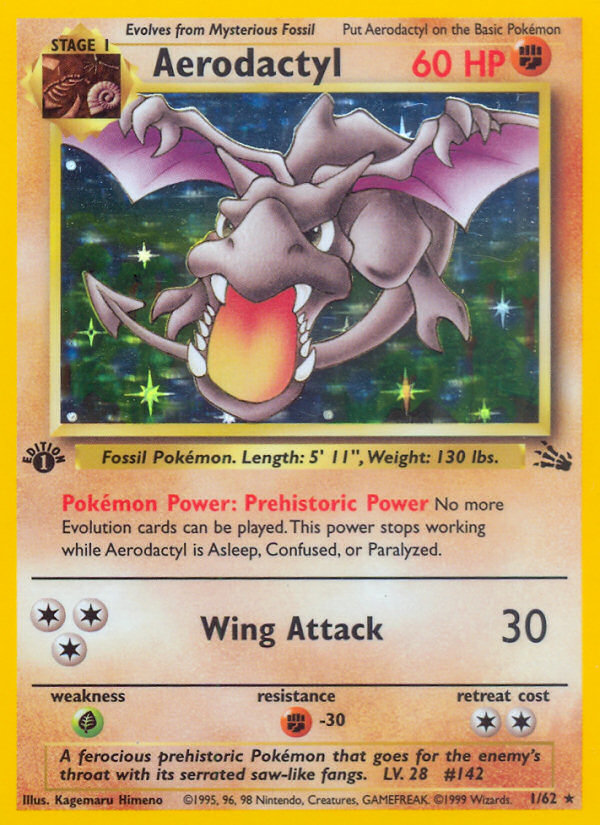
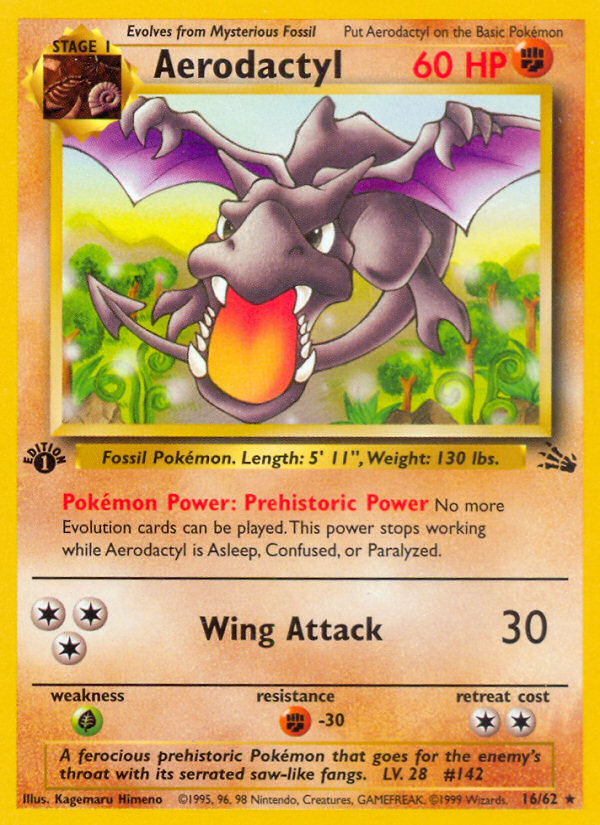
Fossil's Aerodactyl as the holo rare, 1/62, and the non-holo rare, 16/62. The foil in the artwork window is what separates them.
The rarity symbol won't separate them, since both versions carry the same star. The foil is the difference, and the market prices it clearly. In September 2026, TCGplayer's Near Mint market price for the Unlimited holo Aerodactyl was about $39, against roughly $8 for the non-holo. The Unlimited holo Clefable sat near $38, against about $8 for its non-holo twin.
Where reverse holos came from
Reverse holos arrived late in the Wizards era. Some of the earliest English examples were Pokémon League promos, including the Pichu #35 Black Star Promo, released through the League in April 2001 with foil across the card body and a plain artwork window. Legendary Collection in 2002 was the first set to put reverse holos into booster packs, using a busy pattern collectors call fireworks.
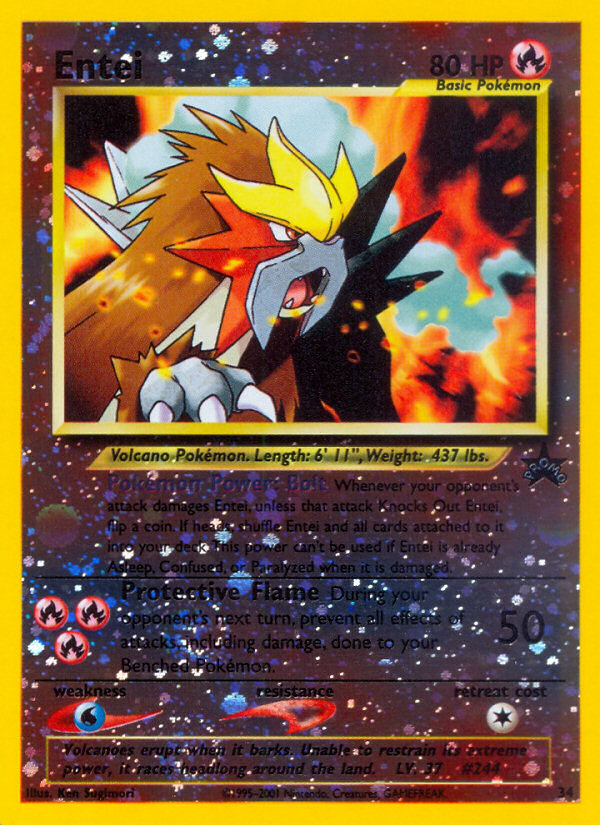
Entei #34, the first reverse holo card released outside Japan.
Since Legendary Collection, every English booster pack has included a reverse holo, and by the Diamond & Pearl era nearly every card in a set had a reverse holo version. That is why modern collectors often chase a "master set" containing both the regular and reverse version of each card.
Which is worth more
There is no single rule, but a few patterns hold. In modern sets, a reverse holo of a common card usually adds only a small premium, since every pack contains one. A holo rare is scarcer by design and generally commands more than the non-holo version of the same card, as the Aerodactyl and Clefable numbers above show.
Early reverse holos are a different story. They were printed in small numbers, and high grades are scarce. PSA 9 copies of the Pichu #35 reverse holo sold for between $465 and $800 in September 2026, for a card whose raw Near Mint copies trade for around $90.
Special foils
Modern sets have added finishes that go beyond these three. Amazing Rares, which debuted in Vivid Voltage in 2020, let the Pokémon's artwork break out of its frame onto a splash of rainbow foil, so the card reads as neither a standard holo nor a reverse. Full arts, textured cards, and illustration rares each push the foil further. They're worth their own guides, but the basic test still works: tilt the card and watch where the light goes.
Checking a card in ten seconds
Tilt the card under a single light source. Shine inside the artwork only means holo. Shine everywhere except the artwork means reverse holo. No shine means non-holo. For graded cards, the label spells it out: our Pichu's PSA label reads "REVERSE HOLO," and holo rares are marked "HOLO."
Foil is one piece of reading a vintage card. The edition is another, covered in our guides to 1st Edition Pokémon cards and shadowless Pokémon cards.

PSA 9 · Wizards Black Star Promo, 2001
A Pokémon League promo from April 2001, one of the earliest English reverse holos. PSA 9 Mint, cert 46023642.
$825.00 View card

PSA 9 · Gym Heroes, 2000
Atsuko Nishida's Dragonair, a Gym Heroes holo rare. PSA 9 Mint, cert 61005772.
$275.00 View card

PSA 10 · Vivid Voltage, 2020
Rayquaza 138/185, Amazing Rare
One of the Amazing Rares that debuted in Vivid Voltage. PSA 10 Gem Mint, cert 57571609.
$250.00 View card
Keep reading
- Vintage Pokémon cards, era by era: a collector's guide
- Wizards Black Star Promos, 1999 to 2003
- Diamond & Pearl era cards: LV.X and Mitsuhiro Arita
- Vivid Voltage and the Amazing Rares
Browse the graded and ungraded Pokémon cards we carry in Artifacts.
The sabi journal
Stories behind the things we carry