
Pokémon Diamond and Pearl reached North America on April 22, 2007, and the card game had already moved into the Sinnoh era that February. From Diamond & Pearl in 2007 to Arceus in late 2009, eleven English sets put a level number on every Pokémon, introduced LV.X cards, and kept a reverse holo in every pack. This is how that era worked, what came in the packs, and where four cards from it fit: a Secret Wonders Blastoise, a Great Encounters Jigglypuff, and two Mitsuhiro Arita reverse holos from Legends Awakened and Supreme Victors.
The Diamond & Pearl and Platinum sets
The Diamond & Pearl series ran through seven English sets: Diamond & Pearl (February 2007), Mysterious Treasures (August 2007), Secret Wonders (November 2007), Great Encounters (February 2008), Majestic Dawn (May 2008), Legends Awakened (August 2008), and Stormfront (November 2008). The Platinum series followed with Platinum (February 2009), Rising Rivals (May 2009), Supreme Victors (August 2009), and Arceus (November 2009). The HeartGold & SoulSilver series took over in February 2010.
LV.X, levels, and Poké-Powers
The era's signature card was the LV.X. Rather than evolving, a LV.X card was played on top of an Active Pokémon with the same name, and it kept all of that Pokémon's attacks and powers while adding its own. The artwork was a 3D render that burst out of the frame. LV.X cards debuted in Diamond & Pearl and made their last set appearance in Arceus.
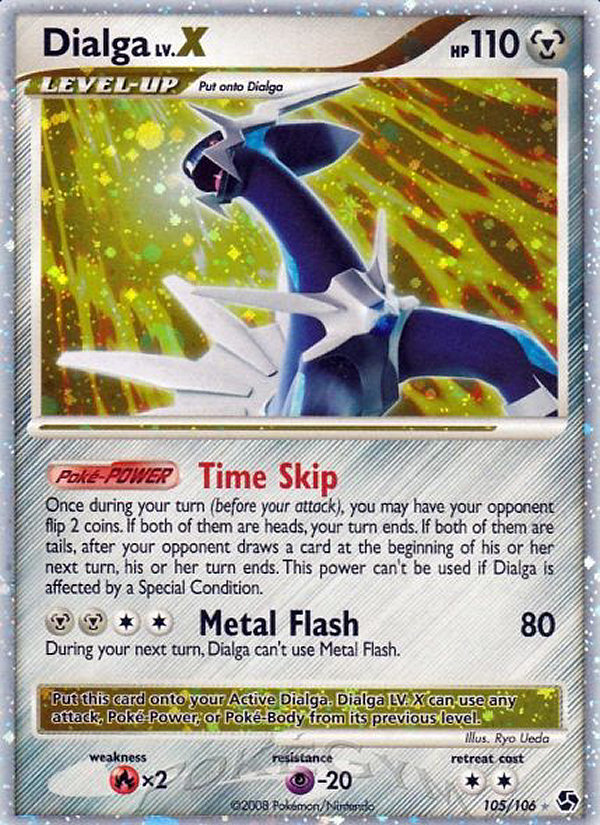
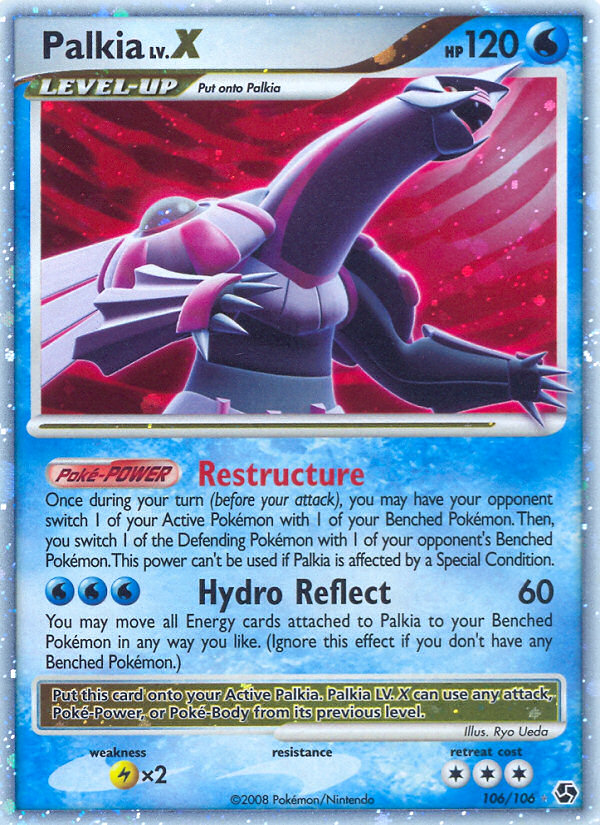
Dialga LV.X 105/106 and Palkia LV.X 106/106 from Great Encounters, with the 3D artwork that breaks out of the frame.
Every Pokémon card in these sets printed a level next to its name, like Blastoise LV.52 or Garchomp LV.71. The number had no effect on play. Abilities didn't exist yet; cards used Poké-Powers and Poké-Bodies, which Black & White replaced with Abilities in 2011. Platinum added Pokémon SP, special cards tied to a trainer or group, such as Pokémon C for Cynthia and Pokémon FB for the Frontier Brains, and it introduced the Lost Zone. There was no Dragon type yet either, which is why Dragonite and Garchomp from these years are Colorless.
What came in a booster pack
Diamond & Pearl era packs held 10 cards, including at least one rare and a reverse holo, and booster boxes held 36 packs. When Secret Wonders launched in November 2007, packs were listed at $3.79 and theme decks at $11.99. Legends Awakened packs came in four wrapper designs, featuring Lucario, Giratina, Luxray, and Rhyperior.
Retail also sold blister packs with promo cards and collector's tins. Secret Wonders two-pack blisters came with a reverse holo Squirtle or Carvanha, and Supreme Victors three-pack blisters came with a Cosmos holo Manaphy or Regigigas. In 2009, Walgreens sold collector's tins that included a Cracked Ice holo Garchomp.
As of September 2026, PriceCharting tracked sealed packs at about $600 for Secret Wonders, $440 for Supreme Victors, $300 for Legends Awakened, and $205 for Great Encounters. Sealed boxes from these sets sell only once or twice a year.
Secret Wonders and Blastoise
Secret Wonders came out on November 7, 2007, with 132 cards. Its LV.X cards were Gardevoir and Honchkrow, and its theme decks were Lavaflow and Powerhouse. Blastoise, card 2/132, is a holo rare illustrated by Daisuke Ito, whose first Pokémon card was a Palkia promo. It is a LV.52 Blastoise with 120 HP, a Poké-Power called Waterlog, and a Hydro Pump attack that starts at 50 damage.

Ungraded · Secret Wonders, 2007
Daisuke Ito's Blastoise LV.52, the holo rare from Secret Wonders. Ungraded, sold as pictured.
$130.00 View card
Great Encounters and Jigglypuff
Great Encounters came out on February 13, 2008, with 106 cards built around the legendary pairs of Sinnoh, with LV.X cards for Dialga, Palkia, Darkrai, and Cresselia. Its theme decks were Eternal Time, Infinite Space, and Endless Night. Jigglypuff 72/106 is a common with a story behind the art: Kenkichi Toyama, who drew it, worked as a designer on the Pokémon video games and illustrated only seven cards. It is a LV.23 Jigglypuff with 60 HP and two attacks, Hypnotic Gaze and Expand.

Ungraded · Great Encounters, 2008
Kenkichi Toyama's Jigglypuff, one of only seven cards he illustrated. Ungraded, sold as pictured.
$16.00 View card
Mitsuhiro Arita's Dragonite and Garchomp
Mitsuhiro Arita is one of the Pokémon card game's original illustrators, and he is credited with more than 600 cards, including the Base Set Charizard and Pikachu. His work runs across the game's history, from the Jungle Clefable in our Jungle guide to these two cards from 2008 and 2009.
Legends Awakened, released on August 20, 2008, was the largest Diamond & Pearl set at 146 cards, headlined by Regigigas and Heatran. It had seven LV.X cards, among them Mewtwo, Azelf, Mesprit, and Uxie, and it completed the Unown run with the letters that earlier sets had skipped, along with ! and ?. Dragonite 2/146 is a LV.61 Colorless Pokémon with 140 HP, and its Draco Meteor attack can hit every one of the opponent's Pokémon on a coin flip.

Ungraded · Legends Awakened, 2008
Mitsuhiro Arita's Dragonite LV.61 in the reverse holo print, with the foil across the card body. Ungraded, sold as pictured.
$175.00 View card
Supreme Victors, released in August 2009, has 153 cards in total, with secret rare versions of Articuno, Moltres, and Zapdos and shiny Milotic, Relicanth, and Yanma. It introduced Pokémon C for Cynthia, the Sinnoh Champion, and Pokémon FB for the Frontier Brains, and its LV.X cards included Garchomp C and Rayquaza C. Garchomp 5/147 is a different card from Garchomp C LV.X. It is a LV.71 Garchomp with 130 HP, no retreat cost, a Poké-Body called Dragon Intimidation, and two attacks, Guard Claw and Speed Impact.
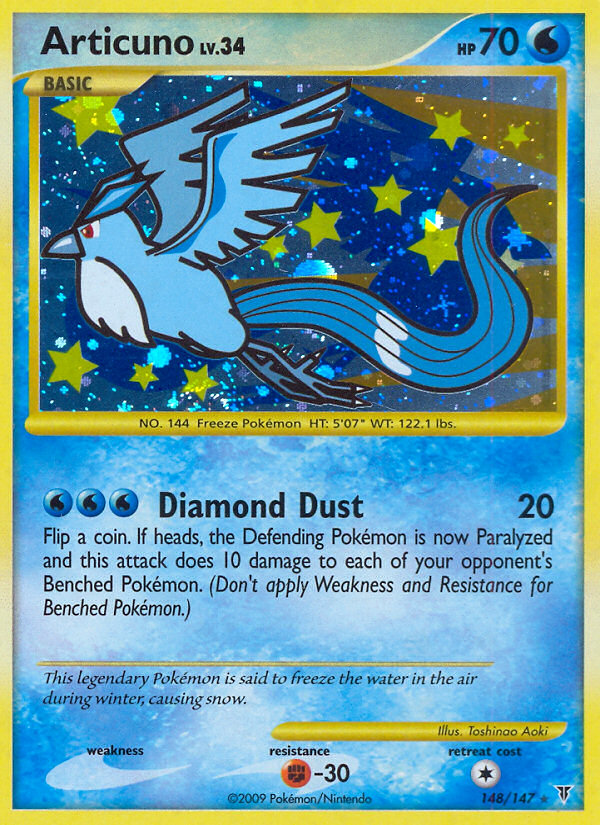
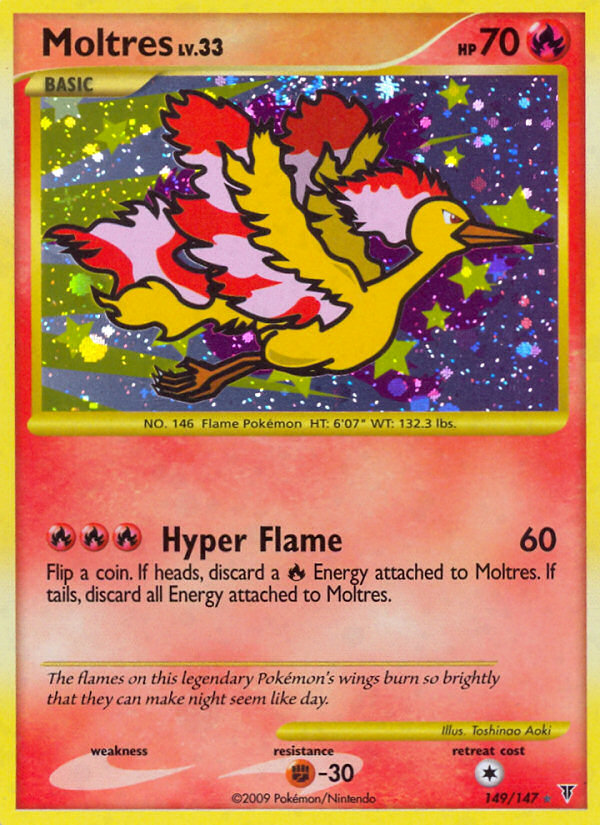
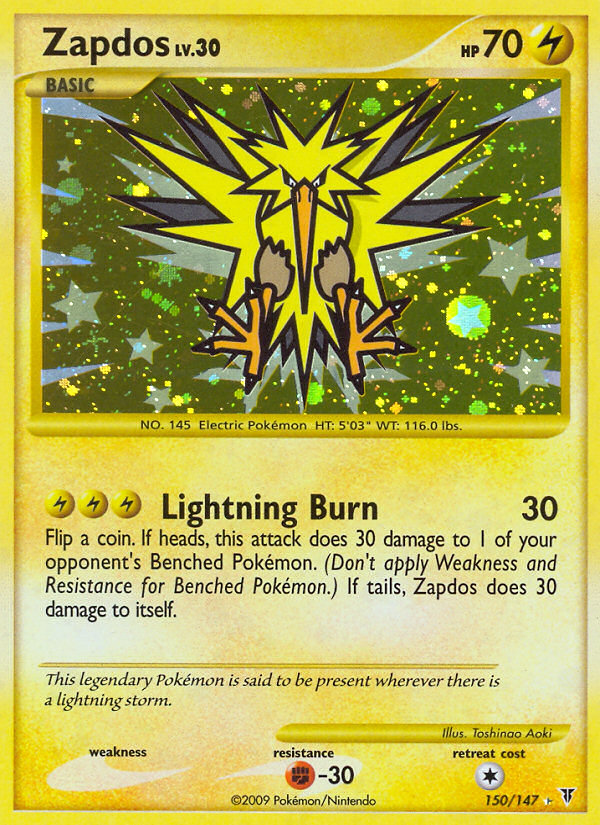
The secret rare Articuno, Moltres, and Zapdos from Supreme Victors, numbered 148/147, 149/147, and 150/147.

Ungraded · Supreme Victors, 2009
Mitsuhiro Arita's Garchomp LV.71 in the reverse holo print. Ungraded, sold as pictured.
$36.00 View card
Both cards exist as regular holos and as reverse holos. On a reverse holo, the foil covers the card body and the artwork stays matte, as we explain in our guide to holo and reverse holo cards.
The world from 2007 to 2009
Diamond and Pearl sold more than 17 million copies worldwide and introduced the Global Trade Station, which let players trade Pokémon online. Pokémon Battle Revolution came to the Wii in June 2007 and used the Nintendo DS as a controller. The Wii itself had launched in November 2006 and was hard to find through much of 2007. The original iPhone went on sale on June 29, 2007, and the App Store opened in July 2008. Super Smash Bros. Brawl arrived in March 2008, the Diamond and Pearl anime started on Cartoon Network in June 2007, and Pokémon Platinum sold more than 805,000 copies in North America in its first two weeks in March 2009.
The business behind the cards changed too. Pokémon USA took over distribution of the card game from Nintendo of America in 2006, and in April 2009 Pokémon USA and Pokémon UK merged to form The Pokémon Company International, which still runs the game outside Asia.
Collecting the era today
Collectors come to these sets for the LV.X cards, the secret rare birds in Supreme Victors, the Arita artwork, and the reverse holos, which were printed for nearly every card and make a master set twice as long. Compared with the Wizards-era Neo sets, singles are still relatively affordable, while sealed packs and boxes have become scarce.
Keep reading
- Vintage Pokémon cards, era by era: a collector's guide
- Holo vs reverse holo Pokémon cards
- The Neo era: Genesis, Discovery, Revelation, and Destiny
- Why there's no Hidden Fates booster box: Pokémon's special sets
Browse the graded and ungraded Pokémon cards we carry in Artifacts.
Frequently asked questions
What is a LV.X Pokémon card? A card from the Diamond & Pearl and Platinum eras that was played on top of an Active Pokémon with the same name. It kept that Pokémon's attacks and powers and added its own. LV.X cards ran from Diamond & Pearl in 2007 to Arceus in 2009.
Why do Diamond and Pearl Pokémon cards show a level? From Diamond & Pearl through Arceus, every Pokémon card printed a level next to its name, like Garchomp LV.71. The number had no effect on play.
Is Supreme Victors Garchomp the same as Garchomp C LV.X? No. Garchomp 5/147 is a regular Stage 2 holo rare, with a reverse holo version. Garchomp C LV.X is a separate card, 145/147, tied to Cynthia.
Who is Mitsuhiro Arita? One of the original Pokémon card illustrators, credited with more than 600 cards, including the Base Set Charizard and Pikachu, the Jungle Clefable, and the Legends Awakened Dragonite and Supreme Victors Garchomp.
How many cards are in a Diamond and Pearl era booster pack? Ten, including at least one rare and a reverse holo. Booster boxes held 36 packs.
The sabi journal
Stories behind the things we carry