
In June 1999 the Pokémon Trading Card Game had been on American shelves for about five months, and kids were already trading it at every lunch table. Jungle was its first expansion: 64 cards, three pack designs, and a set of Pokémon the Base Set had left out, from Snorlax and Scyther to the three Eeveelutions. This is what the set was, what came in a Jungle booster pack, which cards collectors still chase, and what the summer it landed in looked like.
What was the Pokémon Jungle set?
Wizards of the Coast released Jungle in English on June 16, 1999. It was an English version of Pokémon Jungle, a 48-card Japanese expansion from March 1997. Wizards took the Japanese list and printed each of its 16 holo rares a second time as a non-holo rare, which is how the English set reached 64 cards: 16 holo rares, 16 non-holo rares, 16 uncommons, and 16 commons. The set symbol is a small Vileplume flower, printed at the lower right of the artwork.
The release date itself has a story. According to PSA, Jungle was first planned for August, and Wizards moved it up to June after learning that Topps would be releasing its own Pokémon trading cards that summer. The set added 45 new Pokémon, brought back Pikachu and Electrode with new attacks, and included only one Trainer card, Poké Ball.
Jungle was printed in two runs. The first carries a small black 1st Edition stamp at the lower left of the artwork; the later Unlimited run does not. Our guide to 1st Edition Pokémon cards covers where to find the stamp and how much it changes a card's value.
What came in a Jungle booster pack
A Jungle booster pack held 11 cards: seven commons, three uncommons, and one rare. Roughly one pack in three swapped the rare for a holo. A booster box held 36 packs, split across three wrapper designs featuring Scyther, Wigglytuff, and Flareon. The mix of designs inside a box varied: one 1st Edition box that sold through ComicConnect for $14,900 in December 2020 was listed with 13 Scyther packs, 12 Flareon packs, and 11 Wigglytuff packs.
Jungle also came in two 60-card theme decks, released the same day at $9.99 each. Power Reserve paired Grass and Psychic Pokémon around a holo Kangaskhan, and Water Blast paired Water and Fighting around a holo Vaporeon. Each included a rulebook, damage counters, and a Vileplume coin for flips.
Sealed Jungle is now a collectible in its own right. As of September 2026, PriceCharting tracked a sealed 1st Edition Jungle pack at about $500 and an Unlimited pack at about $390. Sealed 1st Edition boxes trade so rarely that recent sales have ranged from about $8,400 to more than $34,000.
The cards collectors chase
Jungle's 16 holo rares are Clefable, Electrode, Flareon, Jolteon, Kangaskhan, Mr. Mime, Nidoqueen, Pidgeot, Pinsir, Scyther, Snorlax, Vaporeon, Venomoth, Victreebel, Vileplume, and Wigglytuff. PSA calls Flareon, Jolteon, and Vaporeon the set's "Big Three."

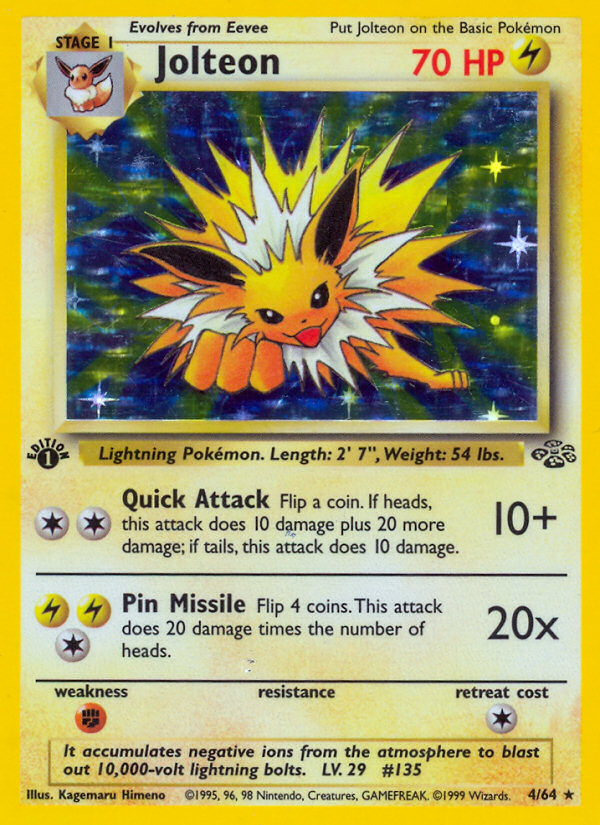
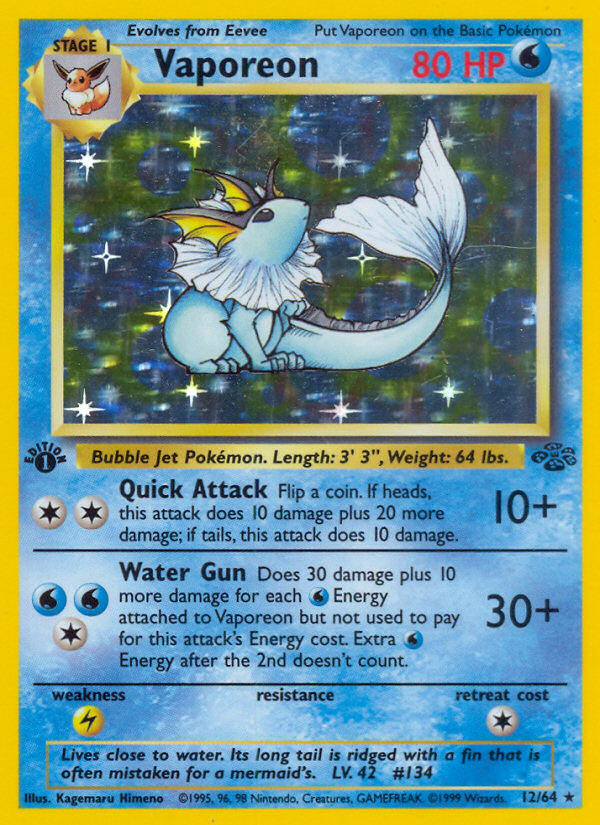
Jungle's Big Three: Flareon 3/64, Jolteon 4/64, and Vaporeon 12/64.
The most famous card in the set is a common. Pikachu 60/64, illustrated by Ken Sugimori, attacks with Spark, a move the Pikachu in the video games couldn't learn until years later. PSA calls it "one of the most coveted common cards" in the hobby. A version stamped with a W appeared in the September 1999 issue of The Duelist, Wizards' own magazine, and the artwork was reprinted in Legendary Collection in 2002. The 1st Edition copy is the one most collectors want, and like the rest of Jungle, it is hard to find in high grade because the blue back borders chip easily.

PSA 9 · Jungle, 1999
Ken Sugimori's Jungle Pikachu from the first print run, graded PSA 9 Mint. Cert 41432897.
$250.00 View card
The Jungle No Symbol holos
Early in the Unlimited print run, Jungle's holo rares came off the press without the Vileplume set symbol. The error traces back to the symbol missing from the black printing plate, and all 16 English holos were affected before it was corrected. Because the mistake happened after the 1st Edition run, a No Symbol holo never carries a 1st Edition stamp. PSA recognizes the variety and prints "No Symbol" on the label, which is why these cards are collected as a set of their own.
Clefable 1/64 is the first card in the set. Mitsuhiro Arita painted it, and it plays Metronome, which copies an opponent's attack, and Minimize, which reduces incoming damage. Clefable is also one of only four Wizards-era cards ever printed with a Prerelease stamp, a version handed out at early Pokémon League events. The same holo artwork was later reprinted in Base Set 2.

PSA 8 · Jungle, 1999
Mitsuhiro Arita's Clefable from the early Unlimited run printed without the set symbol. PSA 8 NM-MT, with the error on the label. Cert 46655952.
$100.00 View card
Summer 1999: the world around the cards
Jungle arrived at the start of the summer when Pokémon went from popular to everywhere. The anime had moved from syndication to Kids' WB in February, which put the show on network television. Pokémon Pinball came out on June 28 with a rumble motor built into the cartridge. Pokémon Snap followed on July 26 for the Nintendo 64, and players could take the game to Blockbuster and print their in-game photos as stickers at a kiosk.
Topps also released its own Pokémon trading cards in 1999, built from stills of the TV show, and Hasbro had picked up the toy license the year before. The Beanie Baby craze was still running, and a few years earlier schools had banned Tamagotchis. By that fall, school districts in Pennsylvania and New York were banning Pokémon cards too. One principal explained that younger students were "getting suckered out of their more valuable cards."
The rest of the year moved even faster. Fossil followed in October, just ahead of the first movie and its theater promos, and those promos started the run of Black Star Promos that Wizards kept printing until 2003.
Collecting Jungle today
Jungle is one of the more approachable vintage sets because it is small and its Unlimited cards were printed in large numbers. Collectors tend to build it in a few ways: the 16 holos in Unlimited, the full 1st Edition set, the 16 No Symbol holos, or sealed packs in all three wrapper designs. PSA runs a Set Registry for 1st Edition Jungle, where collectors rank their graded sets against each other.
Condition is the main challenge with Jungle, since its blue borders show every chip along the edges and older holos often have light scratches across the foil that only show under a lamp. If you are trying to tell a holo from its non-holo twin, our guide to holo and reverse holo cards explains what to look for.
Keep reading
- Vintage Pokémon cards, era by era: a collector's guide
- Pokémon Fossil (1999): Aerodactyl and the fall of the first movie
- What is a shadowless Pokémon card?
- 1st Edition Pokémon cards: what the stamp means
Browse the graded and ungraded Pokémon cards we carry in Artifacts.
Frequently asked questions
When did the Pokémon Jungle set come out? Jungle was released in English on June 16, 1999, as the first expansion to the Base Set. The Japanese version, Pokémon Jungle, came out in March 1997.
How many cards are in a Jungle booster pack? Eleven: seven commons, three uncommons, and one rare. About one pack in three had a holo rare in place of the regular rare. A booster box held 36 packs.
How many cards are in the Jungle set? Sixty-four: 16 holo rares, 16 non-holo rares, 16 uncommons, and 16 commons. The 16 non-holo rares reuse the artwork of the 16 holos.
What is a Jungle No Symbol card? An early Unlimited holo from Jungle printed without the Vileplume set symbol. All 16 holos were affected before the error was corrected, and PSA labels graded copies as "No Symbol."
Is the Jungle Pikachu rare? No. Pikachu 60/64 is a common, but it is one of the most sought-after commons in the hobby, especially in 1st Edition and in high grades, since clean copies with sharp edges are hard to find.
The sabi journal
Stories behind the things we carry