
Pick up two copies of the same 1999 Base Set card and they can look identical until you tilt them toward the light and look at the right edge of the artwork. On one, a dark band runs down the side of the frame, giving the picture a raised look. On the other, the frame sits flat against the card. The flat one is a shadowless card, and that small missing shadow is often the difference between a card worth tens of dollars and one worth hundreds or more.
Three prints of the same set
Wizards of the Coast released the Pokémon Trading Card Game in the United States in January 1999, and the first set, known simply as Base Set, went through several print runs. Collectors group them into three.
The first is 1st Edition, which carries a small black "Edition 1" stamp below the artwork and has no drop shadow. The second is what collectors call Shadowless: no stamp, and still no shadow. The third is Unlimited, the long-running print that followed, with no stamp and a drop shadow added along the right edge of the artwork box. Unlimited was printed in far larger numbers than the two early runs, which is why it is the version most people found in their childhood binders.
So every 1st Edition Base Set card is also shadowless, but most shadowless cards are not 1st Edition. When collectors say "shadowless," they almost always mean that second, unstamped print.
How to spot a shadowless card
Start with the shadow, since it is the fastest and most reliable tell. Look at the right edge of the yellow frame around the artwork. Unlimited cards have a darker band running down that side, as if the picture were a raised panel. Shadowless cards have none, and the frame meets the card's background cleanly.
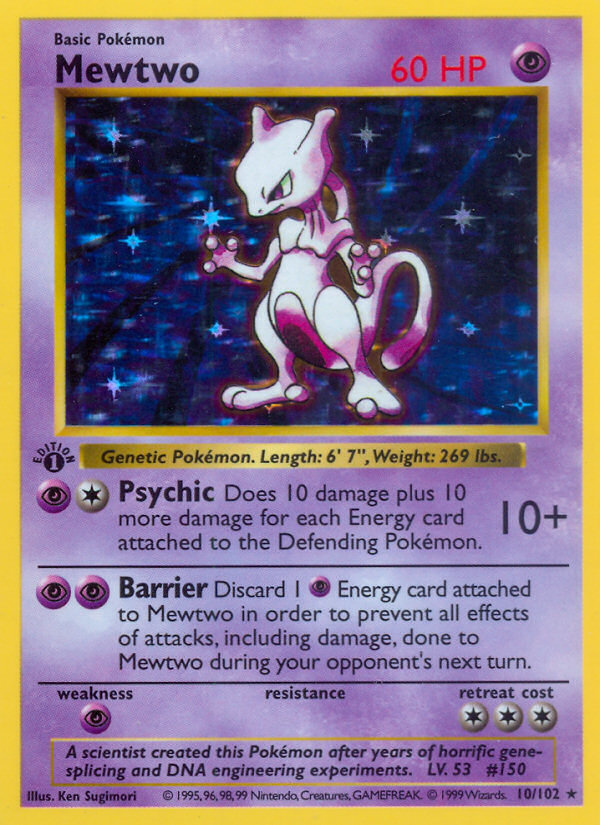
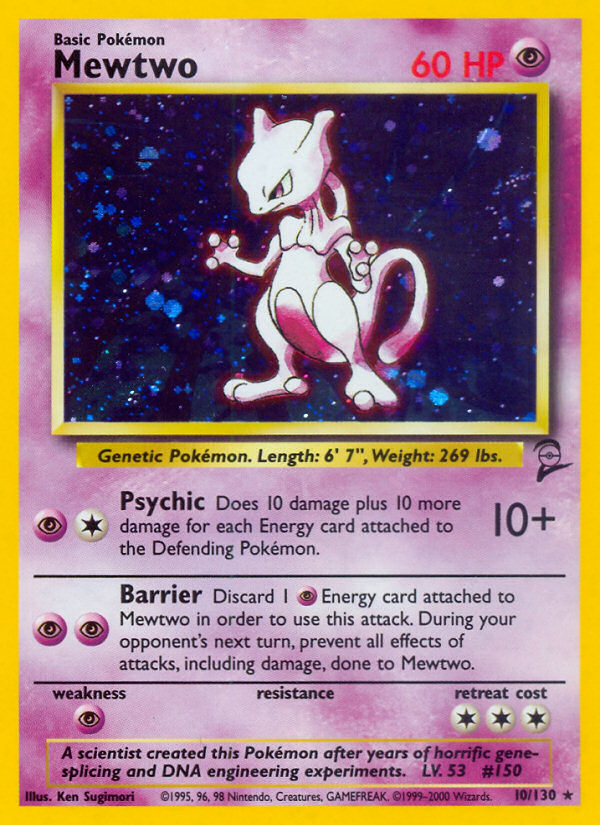
Left, a 1st Edition Base Set Mewtwo 10/102, printed without the drop shadow. Right, the same artwork in the 2000 Base Set 2 reprint, 10/130, with the shadow along the right edge of the artwork box.
The text is the second clue. On Unlimited cards the HP figure at the top right is set in a heavier, bolder type, while shadowless cards use a thinner weight that looks slightly lighter on the page. Unlimited cards also tend to print a little lighter and brighter overall, though color alone is too variable between individual cards to rely on.
Then confirm the card is Base Set at all. Base Set cards are numbered out of 102 and have no set symbol in the bottom right corner of the artwork box. Wizards reprinted many of the same cards in Base Set 2 in 2000 and again in Legendary Collection in 2002, and those reprints carry their own set symbols and numbering, out of 130 and 110 respectively. A card with a set symbol cannot be a Base Set shadowless, however flat its artwork looks.
Finally, check for the stamp. If there is an "Edition 1" mark below the artwork on the left side, the card is 1st Edition rather than the unstamped shadowless print. Our guide to 1st Edition Pokémon cards covers the stamp in detail.
Only Base Set was ever shadowless
The drop shadow arrived during Base Set's print life and never left. Jungle, which followed in the summer of 1999, and every set after it was printed with the shadow on every run, including their 1st Edition prints. Look at the right edge of the artwork on our 1st Edition Jungle Pikachu and the shadow is plainly there.
That answers a question collectors ask often: not every 1st Edition card is shadowless. Only 1st Edition Base Set cards are. A 1st Edition card from Jungle, Fossil, Team Rocket, or the Gym and Neo sets will always show the shadow, and that is exactly how it should look.
Why collectors pay more
Shadowless cards come from a much smaller print than Unlimited, and they were printed at the very start of the craze, when most cards went straight into pockets and playground trades rather than sleeves. Clean copies are scarce, and the gap widens at the top grades.
Base Set Mewtwo shows the scale of it. In September 2026, PriceCharting tracked PSA 10 copies of the shadowless Mewtwo at around $13,100, against roughly $4,150 for a PSA 10 Unlimited copy of the same card. The artwork, the attacks, and the card number are all identical. The missing shadow is the whole difference.
Buying a shadowless card
Ask for a straight-on photo that shows the full right edge of the artwork box, and a second photo of the HP text. Sellers sometimes mislabel Unlimited cards as shadowless in good faith, and photos taken at an angle can hide the shadow. For valuable cards, a graded copy removes most of the guesswork, since the major grading companies identify the print on the label.
If you are still learning to read vintage cards, the foil is the next thing to understand. Our guide to holo vs reverse holo explains what the shine on a card tells you.

PSA 9 · Jungle, 1999
Ken Sugimori's Jungle Pikachu with the 1st Edition stamp. PSA 9 Mint, cert 41432897.
$250.00 View card
Keep reading
- When did Pokémon cards come out? The history of the Pokémon TCG, 1996 to today
- Vintage Pokémon cards, era by era: a collector's guide
- 1st Edition Pokémon cards: what the stamp means
- Pokémon Jungle (1999): packs, Pikachu, and the No Symbol holos
- Holo vs reverse holo Pokémon cards
Browse the graded and ungraded Pokémon cards we carry in Artifacts.
The sabi journal
Stories behind the things we carry