
By the summer of 2000, anyone who had played Pokémon Red and Blue knew Kanto's Gym Leaders: Brock and his rock types in Pewter City, Misty in Cerulean, Lt. Surge in Vermilion, Erika in Celadon. Gym Heroes put those leaders on the cards. Released on August 14, 2000, it was the first English set where a Pokémon belonged to someone, and at 132 cards it was the biggest set yet. This is what the Gym series was, what came in the packs, and where Erika's Dragonair fits.
What was the Gym Heroes set?
Gym Heroes adapted the Japanese Leaders' Stadium expansion from October 1998, with some cards from its follow-up, Challenge from the Darkness. Like the earlier Wizards sets, it was printed in a 1st Edition run and a much larger Unlimited run.
Every Pokémon in the set is an Owner's Pokémon. Instead of a plain Dragonair or Rhydon, the cards read Erika's Dragonair or Brock's Rhydon, with the trainer's portrait over their Gym Badge in the bottom right corner. The idea changed the rules as well as the art: an Owner's Pokémon can only evolve from a Pokémon with the same owner, so Erika's Dragonair has to come from Erika's Dratini. The set features Brock, Misty, Lt. Surge, and Erika, with appearances from Blaine, Sabrina, and Team Rocket.
Gym Heroes also introduced Stadium cards, Trainer cards that stay in play and change the rules for both players. It has seven: the Pewter, Cerulean, Vermilion, and Celadon City Gyms, plus No Removal Gym, Narrow Gym, and The Rocket's Training Gym.
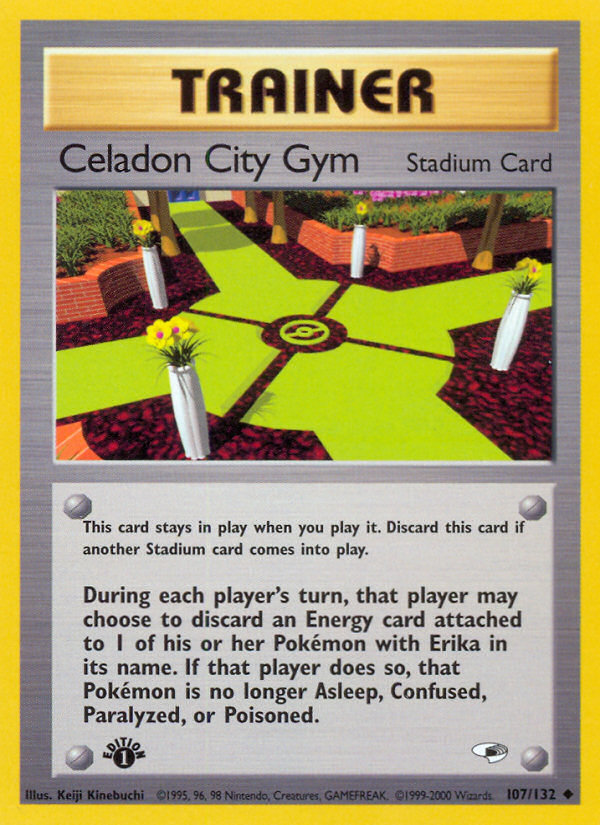
Celadon City Gym 107/132, one of the seven Stadium cards in Gym Heroes.
The Gym Heroes holos
The holo rares take the first 19 numbers in the Gym Heroes card list. Among them are Blaine's Moltres at number 1, Brock's Rhydon at 2, Erika's Dragonair at 4, Lt. Surge's Electabuzz at 6, Lt. Surge's Magneton at 8, Misty's Seadra at 9, Misty's Tentacruel at 10, Rocket's Scyther at 13, and Sabrina's Gengar at 14. Numbers 15 through 19 are holo Trainer cards: Brock, Erika, Lt. Surge, Misty, and The Rocket's Trap.
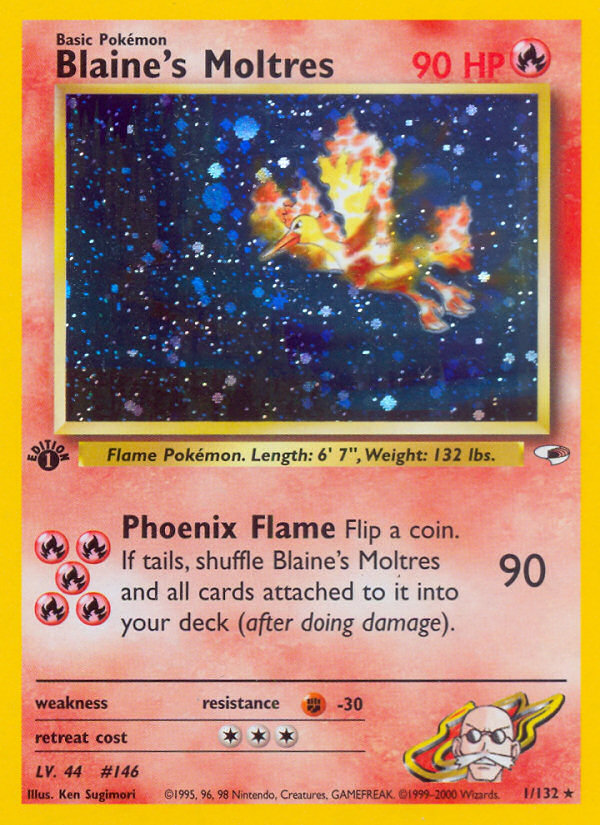
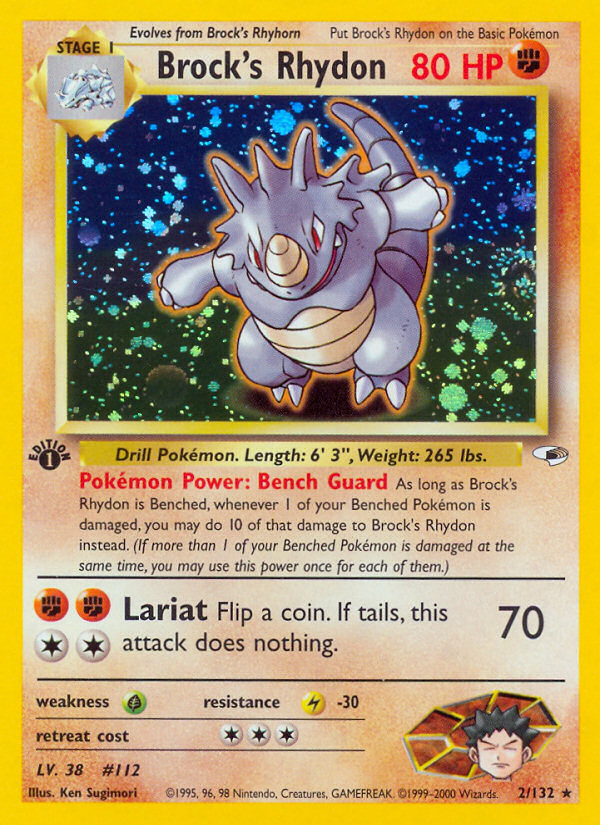
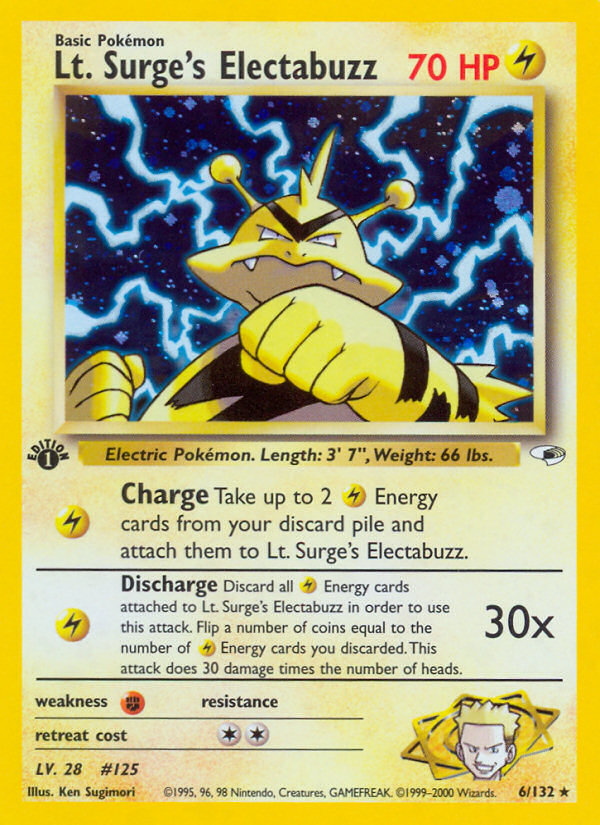
Blaine's Moltres 1/132, Brock's Rhydon 2/132, and Lt. Surge's Electabuzz 6/132, each with its Gym Leader's portrait in the lower right corner.
What came in a Gym Heroes booster pack
The packs followed the Wizards formula: 11 cards, with seven commons, three uncommons, and one rare, a holo in roughly one pack in three, and 36 packs to a box. There were four pack designs, one for each featured Gym Leader, with artwork credited to Ken Sugimori. A Baltimore Sun story from September 2000 put the price of a pack at around $3.
Four 60-card theme decks sold for $9.99 each, one per leader, and each came with a Starmie coin. Brock's deck was built around a holo Rhydon, Misty's around Tentacruel, Lt. Surge's around Magneton, and Erika's around Vileplume.
Sealed Gym Heroes has climbed as far as any vintage product. PSA recounts a collector buying a 1st Edition box for $300 in 2013, and in 2017 PSA valued boxes at $1,000 to $1,100. PriceCharting now puts a 1st Edition box at about $30,000, with 2026 sales between $16,000 and $30,630.
Erika and her Dragonair
In the games, Erika leads the Celadon City Gym, uses Grass-type Pokémon, and awards the Rainbow Badge. Her trainer class is "The Nature-Loving Princess," and she teaches flower arranging. The anime gave her a gym that makes perfume, in the episode "Pokémon Scent-sation!", first aired in the United States in October 1998, where Ash sneaks in disguised as "Ashley." The perfume shows up in the card game too, as the Erika's Perfume Trainer card in Gym Heroes.
Erika's Dragonair 4/132 is a Colorless Stage 1 with 80 HP and two attacks, Blizzard and Take Away. It was illustrated by Atsuko Nishida, who drew early designs for Pikachu and is the only person credited as a Pokémon designer in every generation of the games. PSA singles the card out for its "appealing artwork" and notes that "the Dragon cards in general have a strong following."

PSA 9 · Gym Heroes, 2000
Atsuko Nishida's Dragonair from the Unlimited print of Gym Heroes, graded PSA 9 Mint. Cert 61005772.
$275.00 View card
Gym Challenge and Blaine's Charizard
Gym Challenge followed on October 16, 2000, with another 132 cards built on Challenge from the Darkness. It moved the focus to Blaine, Giovanni, Koga, and Sabrina, added the Cinnabar, Fuchsia, Saffron, and Viridian City Gyms, and included holos like Brock's Ninetales, Lt. Surge's Raichu, Misty's Gyarados, and Sabrina's Alakazam. Its most famous card is Blaine's Charizard, holo 2/132, illustrated by Ken Sugimori. Early copies printed a Fighting symbol in its Roaring Flames attack, which was corrected in later printings.
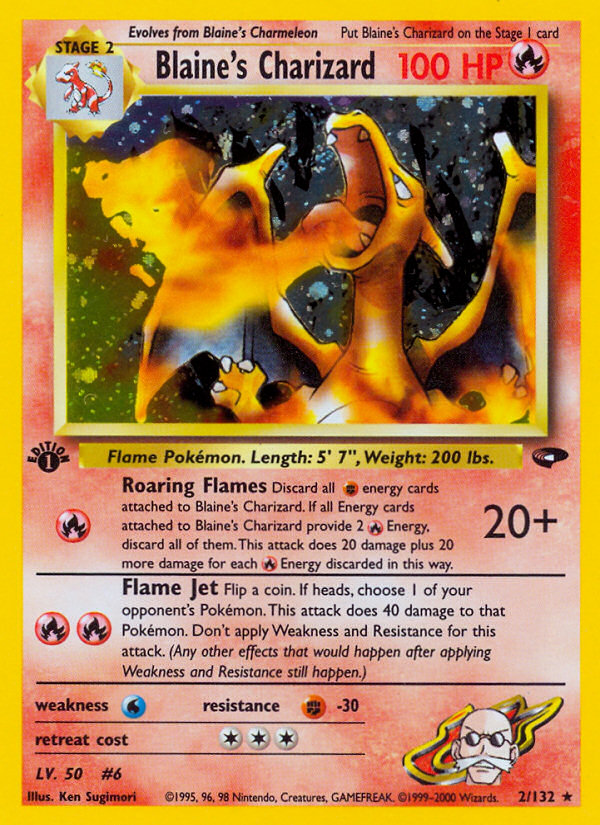
Blaine's Charizard 2/132 from Gym Challenge.
The world in 2000
Pokémon spent 2000 filling every screen it could. Pokémon Stadium came out for the Nintendo 64 on March 6 and became the best-selling console game of the year in North America. The Game Boy Color version of the card game followed on April 10, with Base, Jungle, and Fossil cards inside and a Meowth promo card in the box. Weekly Pokémon League play at game stores that year awarded badges named after the ones in the games.
On July 21, Pokémon the Movie 2000 reached theaters. The first week's ticket buyers got Ancient Mew, and the next week brought a random Moltres, Articuno, or Zapdos, all part of Wizards' Black Star Promos. Burger King ran a second promotion that summer with 24 "power card" toys, and Topps printed a 72-card set of movie cards. In the fall, Pokémon Puzzle League came out on September 25, the first Johto episode of the anime aired on October 14, and Pokémon Gold and Silver launched the next day with 100 new Pokémon.
Outside Pokémon, the year's other playground craze was the Razor scooter, which sold more than five million units in its first six months and won a Toy of the Year award.
Why the Gym sets still matter
After the Gym sets, owned Pokémon returned briefly in the EX era and then disappeared from the main English expansions for about two decades. Journey Together, released on March 28, 2025, was the first main expansion with Trainer's Pokémon since the EX era, and Destined Rivals followed on May 30 with a set built around Team Rocket and rivals like Misty and Cynthia. New players opening those packs are working with the idea Gym Heroes introduced 25 years earlier.
For collectors, Gym Heroes sits between the early Wizards sets and the Neo era. Unlimited holos are still reachable, and 1st Edition holos in high grade are scarce. On the raw market, PriceCharting tracked an ungraded Unlimited Erika's Dragonair at about $72 as of September 2026, and PSA 10 copies at about $2,765. If you are starting with the earlier sets, begin with Jungle and Fossil.
Keep reading
- Vintage Pokémon cards, era by era: a collector's guide
- Team Rocket's Dark Pokémon, from Rocket Gang to Team Rocket Returns
- The Neo era: Genesis, Discovery, Revelation, and Destiny
- Pokémon Fossil (1999): Aerodactyl and the fall of the first movie
Browse the graded and ungraded Pokémon cards we carry in Artifacts.
Frequently asked questions
When did Pokémon Gym Heroes come out? Gym Heroes was released in English on August 14, 2000. Its follow-up, Gym Challenge, came out on October 16, 2000.
How many cards are in the Gym Heroes set? 132 cards, which made it the largest English set at the time. The holo rares are numbers 1 through 19.
What is an Owner's Pokémon? A Pokémon card that belongs to a named trainer, like Erika's Dragonair or Brock's Rhydon. It shows the trainer's portrait over their Gym Badge and can only evolve from a Pokémon with the same owner.
Can Erika's Dragonair evolve from a regular Dratini? No. Under the Gym series rules, Erika's Dragonair can only evolve from Erika's Dratini.
What is the difference between 1st Edition and Unlimited Gym Heroes? 1st Edition cards come from the first print run and carry a small black 1st Edition stamp. Unlimited cards were printed later, in much larger numbers, and have no stamp.
The sabi journal
Stories behind the things we carry