
On the left side of some early Pokémon cards, just below the artwork, sits a small black circle with the word "Edition" curving around a number 1. It is easy to miss, and it is one of the most valuable marks a card can carry. That stamp tells you the card came from the first print run of its set, before the far larger Unlimited print that followed.
What the stamp means
When Wizards of the Coast launched a new English set, it printed an initial run marked 1st Edition, then continued printing the same cards without the stamp. That later print is called Unlimited. The cards are otherwise the same: same artwork, same text, same number. The stamp is simply proof that a card belongs to the smaller, earlier run, which is why collectors will pay a clear premium for it.
Where to find it
Look at the left edge of the card directly below the artwork box, next to the strip that describes the Pokémon's length and weight. The stamp is a solid black circle with "EDITION" set around the edge and a large "1" in the middle. On the vast majority of sets it sits in that same spot, so once you have seen one you will spot it at a glance.
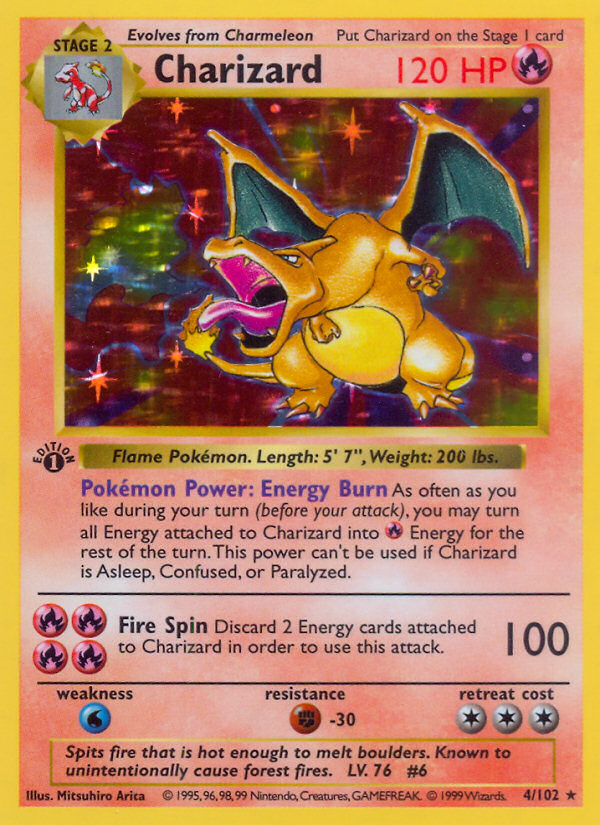
A 1st Edition Base Set Charizard 4/102. The stamp sits at the left end of the strip just below the artwork.
If the space below the artwork is empty, the card is Unlimited, or it comes from a set that never had a 1st Edition print at all.
Which sets have 1st Edition cards
Only English sets printed by Wizards of the Coast carry the stamp, and not all of them. These sets were released in 1st Edition:
- Base Set (1999)
- Jungle (1999)
- Fossil (1999)
- Team Rocket (2000)
- Gym Heroes (2000)
- Gym Challenge (2000)
- Neo Genesis (2000)
- Neo Discovery (2001)
- Neo Revelation (2001)
- Neo Destiny (2002)
Several Wizards sets were never printed in 1st Edition, including Base Set 2, Southern Islands, Legendary Collection, Expedition, Aquapolis, and Skyridge. Wizards' license to the English game ended in 2003, as we cover in our guide to the Black Star Promos, and the English sets released since then have not used the 1st Edition stamp. If you see one on a modern English card, something is wrong.
1st Edition, Shadowless, and Unlimited
Base Set adds one wrinkle. Its earliest prints were made without the drop shadow that runs along the right edge of the artwork box, so a Base Set card can be 1st Edition, Shadowless (no stamp, no shadow), or Unlimited (no stamp, with shadow). Every 1st Edition Base Set card is also shadowless. From Jungle onward, every print carries the shadow, 1st Edition included. Our guide to shadowless Pokémon cards walks through how to tell the Base Set prints apart.
How much the stamp adds
The premium varies by card, but it is rarely small. Using TCGplayer's Near Mint market prices from September 2026:
- Aerodactyl 1/62 from Fossil: about $92 in 1st Edition, against $39 Unlimited
- Pikachu 60/64 from Jungle: about $25 in 1st Edition, against $6 Unlimited
- Erika's Dragonair 4/132 from Gym Heroes: about $393 in 1st Edition, against $122 Unlimited, though 1st Edition copies trade rarely
That is roughly two and a half to four times the Unlimited price for the same card in the same condition. Grading pushes the numbers further. PSA 9 copies of the 1st Edition Jungle Pikachu sold for between $174 and $225 in September 2026, several times what a raw copy brings.
The stamp is not a guarantee of value on its own, though. A 1st Edition common in played condition can still be worth only a few dollars. The stamp multiplies what the card, the set, and the condition are already worth.
Fakes and look-alikes
Because the stamp adds so much, it is the most commonly faked detail on vintage cards. Compare it with a known genuine example: a real stamp is crisp, evenly black, and sits in the standard position, while added stamps are often slightly off in size, placement, or sharpness. Check the rest of the card too, since a stamp on a card from a set that never had a 1st Edition print is an instant giveaway.
Don't confuse the 1st Edition mark with other stamps. Prerelease cards, some promos, and certain tournament cards carry their own stamps, and those are separate collectibles with their own markets.
For expensive cards, buying graded is the simplest protection. The grading label names the edition, so our Fossil Aerodactyl's PSA label reads "1ST EDITION" alongside the grade. If you also want to understand the shine on vintage holos, see our guide to holo vs reverse holo.

PSA 9 · Fossil, 1999
Aerodactyl 1/62, 1st Edition Holo
The first card in the Fossil set, from the 1st Edition print run. PSA 9 Mint, cert 43981927.
$400.00 View card

PSA 9 · Jungle, 1999
Ken Sugimori's Jungle Pikachu with the 1st Edition stamp. PSA 9 Mint, cert 41432897.
$250.00 View card
Keep reading
- When did Pokémon cards come out? The history of the Pokémon TCG, 1996 to today
- Vintage Pokémon cards, era by era: a collector's guide
- What is a shadowless Pokémon card?
- Pokémon Jungle (1999): packs, Pikachu, and the No Symbol holos
- The Neo era: Genesis, Discovery, Revelation, and Destiny
Browse the graded and ungraded Pokémon cards we carry in Artifacts.
The sabi journal
Stories behind the things we carry