
Base Set is the first English Pokémon expansion: 102 cards, released by Wizards of the Coast on January 9, 1999, three years after the Japanese original came out on October 20, 1996. It's the set with Charizard 4/102, the set that invented the words 1st Edition and shadowless, and the set most people mean when they say “the original Pokémon cards.” Here is the full card list, the rarities, the four printings, the theme decks, the error cards, and how Base Set differs from Base Set 2.
For the wider story of where the game came from, start with when Pokémon cards came out.
Base Set at a glance
- Cards: 102. Sixteen Rare Holos, six Rares, twenty Uncommons, twenty-seven Commons, twenty-six Trainers, and seven Energy.
- English release: January 9, 1999, Wizards of the Coast.
- Japanese release: October 20, 1996, Media Factory, sold as a Starter Pack and separate Expansion Pack boosters.
- Numbering: English cards are ordered by card type (Pokémon, then Trainer, then Energy), then by rarity, then alphabetically. That's why Alakazam is 1/102 and Charizard is 4/102.
- Theme decks: Overgrowth (Water and Grass), Zap! (Lightning and Psychic), Brushfire (Fire and Grass), and Blackout (Water and Fighting), plus a 2-Player Starter Set.
- Set symbol: none. Base Set is the only English expansion with no symbol in the artwork box, which is one of the fastest ways to identify it.
Base Set card list: all 102 cards
Numbered in the English order. Type is the Energy type for Pokémon cards.
| # | Card | Type | Rarity |
|---|---|---|---|
| 1/102 | Alakazam | Psychic | Rare Holo |
| 2/102 | Blastoise | Water | Rare Holo |
| 3/102 | Chansey | Colorless | Rare Holo |
| 4/102 | Charizard | Fire | Rare Holo |
| 5/102 | Clefairy | Colorless | Rare Holo |
| 6/102 | Gyarados | Water | Rare Holo |
| 7/102 | Hitmonchan | Fighting | Rare Holo |
| 8/102 | Machamp | Fighting | Rare Holo |
| 9/102 | Magneton | Lightning | Rare Holo |
| 10/102 | Mewtwo | Psychic | Rare Holo |
| 11/102 | Nidoking | Grass | Rare Holo |
| 12/102 | Ninetales | Fire | Rare Holo |
| 13/102 | Poliwrath | Water | Rare Holo |
| 14/102 | Raichu | Lightning | Rare Holo |
| 15/102 | Venusaur | Grass | Rare Holo |
| 16/102 | Zapdos | Lightning | Rare Holo |
| 17/102 | Beedrill | Grass | Rare |
| 18/102 | Dragonair | Colorless | Rare |
| 19/102 | Dugtrio | Fighting | Rare |
| 20/102 | Electabuzz | Lightning | Rare |
| 21/102 | Electrode | Lightning | Rare |
| 22/102 | Pidgeotto | Colorless | Rare |
| 23/102 | Arcanine | Fire | Uncommon |
| 24/102 | Charmeleon | Fire | Uncommon |
| 25/102 | Dewgong | Water | Uncommon |
| 26/102 | Dratini | Colorless | Uncommon |
| 27/102 | Farfetch'd | Colorless | Uncommon |
| 28/102 | Growlithe | Fire | Uncommon |
| 29/102 | Haunter | Psychic | Uncommon |
| 30/102 | Ivysaur | Grass | Uncommon |
| 31/102 | Jynx | Psychic | Uncommon |
| 32/102 | Kadabra | Psychic | Uncommon |
| 33/102 | Kakuna | Grass | Uncommon |
| 34/102 | Machoke | Fighting | Uncommon |
| 35/102 | Magikarp | Water | Uncommon |
| 36/102 | Magmar | Fire | Uncommon |
| 37/102 | Nidorino | Grass | Uncommon |
| 38/102 | Poliwhirl | Water | Uncommon |
| 39/102 | Porygon | Colorless | Uncommon |
| 40/102 | Raticate | Colorless | Uncommon |
| 41/102 | Seel | Water | Uncommon |
| 42/102 | Wartortle | Water | Uncommon |
| 43/102 | Abra | Psychic | Common |
| 44/102 | Bulbasaur | Grass | Common |
| 45/102 | Caterpie | Grass | Common |
| 46/102 | Charmander | Fire | Common |
| 47/102 | Diglett | Fighting | Common |
| 48/102 | Doduo | Colorless | Common |
| 49/102 | Drowzee | Psychic | Common |
| 50/102 | Gastly | Psychic | Common |
| 51/102 | Koffing | Grass | Common |
| 52/102 | Machop | Fighting | Common |
| 53/102 | Magnemite | Lightning | Common |
| 54/102 | Metapod | Grass | Common |
| 55/102 | Nidoran (male) | Grass | Common |
| 56/102 | Onix | Fighting | Common |
| 57/102 | Pidgey | Colorless | Common |
| 58/102 | Pikachu | Lightning | Common |
| 59/102 | Poliwag | Water | Common |
| 60/102 | Ponyta | Fire | Common |
| 61/102 | Rattata | Colorless | Common |
| 62/102 | Sandshrew | Fighting | Common |
| 63/102 | Squirtle | Water | Common |
| 64/102 | Starmie | Water | Common |
| 65/102 | Staryu | Water | Common |
| 66/102 | Tangela | Grass | Common |
| 67/102 | Voltorb | Lightning | Common |
| 68/102 | Vulpix | Fire | Common |
| 69/102 | Weedle | Grass | Common |
| 70/102 | Clefairy Doll | Trainer | Rare |
| 71/102 | Computer Search | Trainer | Rare |
| 72/102 | Devolution Spray | Trainer | Rare |
| 73/102 | Imposter Professor Oak | Trainer | Rare |
| 74/102 | Item Finder | Trainer | Rare |
| 75/102 | Lass | Trainer | Rare |
| 76/102 | Pokémon Breeder | Trainer | Rare |
| 77/102 | Pokémon Trader | Trainer | Rare |
| 78/102 | Scoop Up | Trainer | Rare |
| 79/102 | Super Energy Removal | Trainer | Rare |
| 80/102 | Defender | Trainer | Uncommon |
| 81/102 | Energy Retrieval | Trainer | Uncommon |
| 82/102 | Full Heal | Trainer | Uncommon |
| 83/102 | Maintenance | Trainer | Uncommon |
| 84/102 | PlusPower | Trainer | Uncommon |
| 85/102 | Pokémon Center | Trainer | Uncommon |
| 86/102 | Pokémon Flute | Trainer | Uncommon |
| 87/102 | Pokédex | Trainer | Uncommon |
| 88/102 | Professor Oak | Trainer | Uncommon |
| 89/102 | Revive | Trainer | Uncommon |
| 90/102 | Super Potion | Trainer | Uncommon |
| 91/102 | Bill | Trainer | Common |
| 92/102 | Energy Removal | Trainer | Common |
| 93/102 | Gust of Wind | Trainer | Common |
| 94/102 | Potion | Trainer | Common |
| 95/102 | Switch | Trainer | Common |
| 96/102 | Double Colorless Energy | Energy | Uncommon |
| 97/102 | Fighting Energy | Energy | Basic Energy |
| 98/102 | Fire Energy | Energy | Basic Energy |
| 99/102 | Grass Energy | Energy | Basic Energy |
| 100/102 | Lightning Energy | Energy | Basic Energy |
| 101/102 | Psychic Energy | Energy | Basic Energy |
| 102/102 | Water Energy | Energy | Basic Energy |
The sixteen holos
Cards 1 through 16 are the holographic rares, and they carry most of the set's value: Alakazam, Blastoise, Chansey, Charizard, Clefairy, Gyarados, Hitmonchan, Machamp, Magneton, Mewtwo, Nidoking, Ninetales, Poliwrath, Raichu, Venusaur, and Zapdos. Charizard, Blastoise, and Venusaur are the three starters and the three most sought-after cards. Machamp 8/102 is the odd one out: it was the holo packed into the 2-Player Starter Set, so it's far more common than the other fifteen. How to read the foil on a vintage holo.
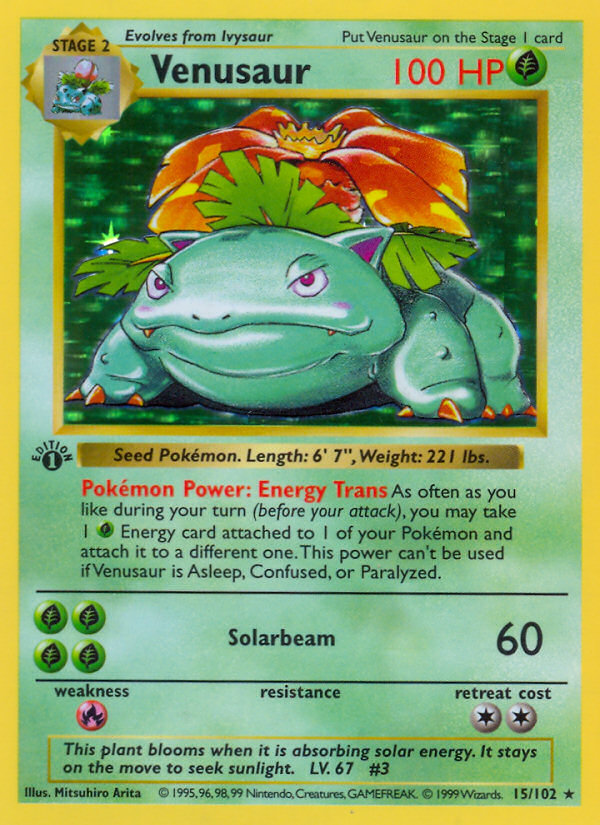
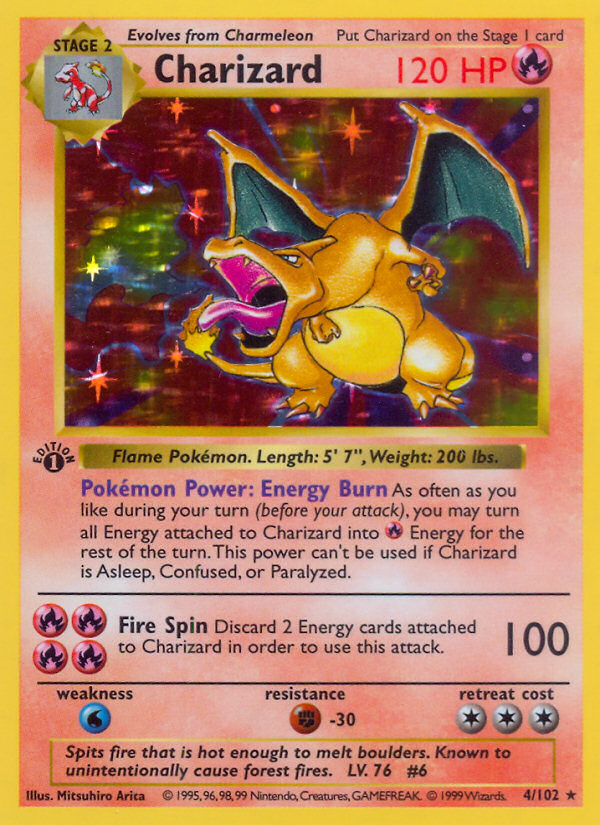
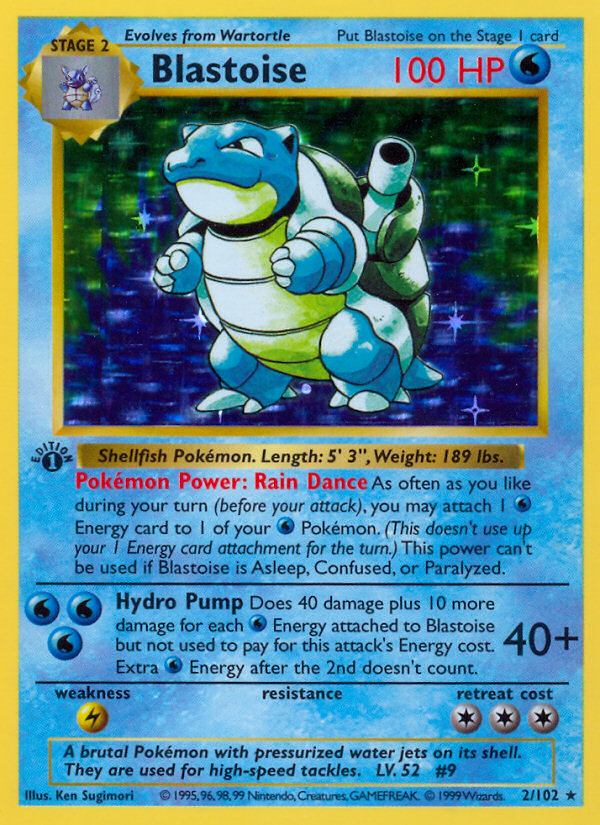
The three starters and the three most valuable cards in the set: Venusaur 15/102, Charizard 4/102, and Blastoise 2/102.
The four printings
Every card above exists in more than one print, and the print matters more than the card number for value.
- 1st Edition. The first print run. Small black “Edition 1” stamp on the left below the artwork, no drop shadow on the right edge of the art box. Every 1st Edition Base Set card is also shadowless. How to spot the stamp.
- Shadowless. The second run. No stamp, still no drop shadow, thinner HP text. This is what collectors mean by “shadowless” on its own. How to tell it from Unlimited.
- Unlimited. The long print that followed, with the drop shadow added and bolder HP text. This is the version most people own. Copyright line reads “1995, 96, 98 Nintendo, Creatures, GAMEFREAK. 1999 Wizards.”
- The 1999-2000 print. A late Unlimited reprint with a “1999-2000” copyright line, distributed for a short period in the UK, Australia, and the US. Same look as Unlimited otherwise.
Shadowless printing exists only for Base Set. Jungle and every set after it shipped with the shadow from the first run onward.
Error cards and variants worth knowing
- Pikachu 58/102, Red Cheeks. The earliest print gave Pikachu red cheeks instead of yellow. Later prints corrected it. Red Cheeks is the one collectors chase.
- Blastoise 2/102 was printed without the word “Stage” in the evolution box on some copies.
- Ninetales 12/102 (shadowless) exists with the attack damage missing.
- Beedrill 17/102 has a “D.efending” typo on early copies.
- Wartortle 42/102 shows Wartortle instead of Squirtle in its own evolution box on early copies.
- Diglett 47/102 exists with the attack Energy symbols rotated 90 degrees.
- Machamp 8/102 has a Cosmos Holo variant exclusive to the 2-Player CD-ROM Starter Set.
- Water Energy 102/102 exists with no space between the margin and the Water symbol.
Corrected error cards generally carry a premium over the standard version. Confirm any of these against a reference image before paying for one.
Base Set vs Base Set 2
Base Set 2 is a different set. Released February 24, 2000, in English only, it reprinted 130 cards drawn from Base Set and Jungle, printed only as Unlimited, with a set symbol (a Pokéball with a 2) in the bottom right of the artwork. If your Charizard says 4/130 or has that symbol, it's the Base Set 2 reprint. Same artwork, far lower value. If it says 4/102 with no symbol, it's Base Set, and the next question is which printing.
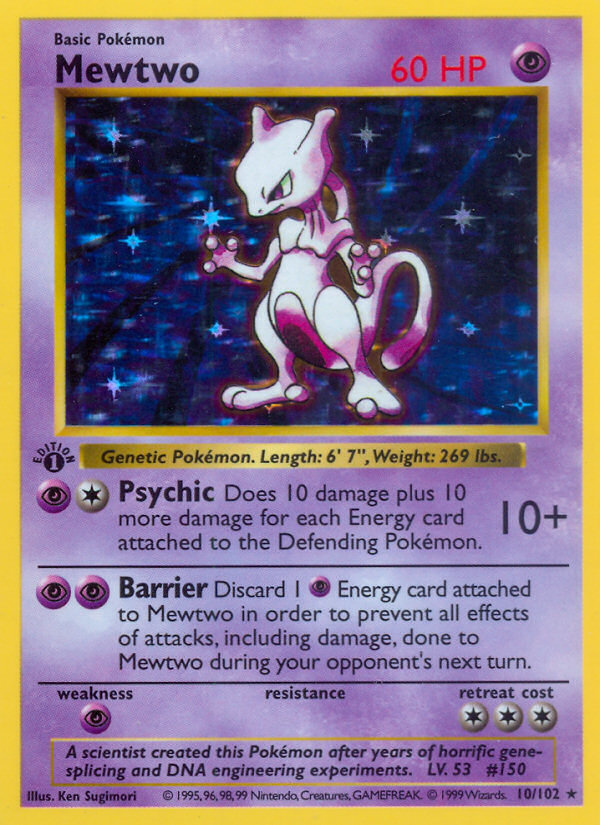
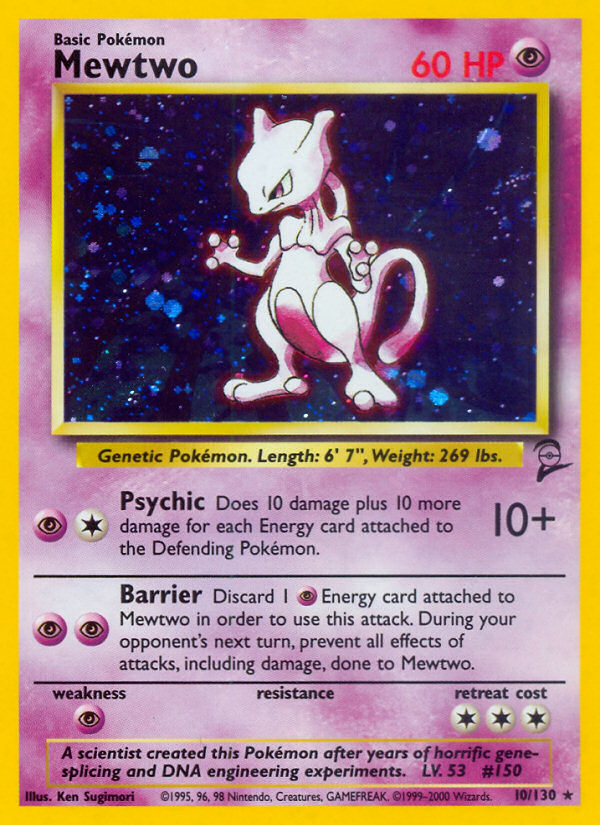
Left, Base Set Mewtwo 10/102 (1st Edition, no shadow, no symbol). Right, the Base Set 2 reprint, 10/130, with the shadow and the 2 symbol at the bottom right of the artwork.
Which Base Set cards are worth money
We don't quote prices here because they move weekly. The pattern is stable:
- The three starters (Charizard, Blastoise, Venusaur) lead by a wide margin, in every printing.
- Mewtwo, Alakazam, Raichu, Zapdos, Chansey, and Magneton form the next tier of holos.
- 1st Edition and shadowless copies of any holo sell for multiples of the Unlimited version.
- Red Cheeks Pikachu is the one common that carries real value.
- Trainer rares like Computer Search, Item Finder, and Professor Oak have a following among players who remember using them, but they're a fraction of holo prices.
- Everything else is worth little raw and only becomes interesting in high grades.
Condition and grade multiply all of it. Browse our graded vintage cards to see what slabbed WOTC-era cards actually list for.
Frequently asked questions
How many cards are in the Pokémon Base Set?
102 in English: 69 Pokémon, 26 Trainers, and 7 Energy. The Japanese set is also 102 cards but is unnumbered and ordered differently.
What is the rarest Base Set card?
By printing, a 1st Edition Charizard in a high grade. By error, the Red Cheeks Pikachu and the shadowless Ninetales with missing damage are the ones collectors hunt. Among normal cards, all sixteen holos share the same pull rate; demand, not print run, is what separates Charizard from Poliwrath.
How do I know if my Base Set card is 1st Edition or shadowless?
Look left below the artwork for the “Edition 1” stamp. Then look at the right edge of the artwork box: no shadow means 1st Edition (with stamp) or shadowless (without); a dark shadow means Unlimited. Full walkthroughs in our 1st Edition and shadowless guides.
What is the difference between Base Set and Base Set 2?
Base Set is the original 102-card 1999 set with no symbol. Base Set 2 is a 130-card 2000 reprint of Base Set and Jungle with a “2” symbol, printed only in Unlimited.
When did the Japanese Base Set come out?
October 20, 1996. Five days earlier, CoroCoro magazine readers could peel a Pikachu and Jigglypuff promo from the magazine, the first TCG cards to reach the public.
Keep reading
- When did Pokémon cards come out? The history of the Pokémon TCG
- Vintage Pokémon cards, era by era
- 1st Edition Pokémon cards: what the stamp means
- What is a shadowless Pokémon card?
- Pokémon Jungle (1999), the set that followed
Sources
- Bulbapedia, Base Set (TCG): card list, rarities, release dates, theme decks, error cards, CoroCoro promos.
- Bulbapedia, Base Set 2: 130 cards, February 24, 2000, reprint composition.
- WikiDex, Base Set (TCG): copyright lines by printing and the 1999-2000 reprint.
- Poké Master Center, The Ultimate Pokémon 1999 WotC Base Set Guide: shadowless template change.
The sabi journal
Stories behind the things we carry