
Live from Sabi · No. 02: Garments 05.13.2026

Some garments are designed to outlive the people who wear them. Kapital's Century Denim is one of them.
The name is literal. One hundred years of denim history, combined into a single garment. Buttons and rivets borrowed from old Levi's. The tradition of sashiko stitching from Edo-period Japan. Two lineages, separated by an ocean and a century, brought into one pair of jeans.
Kapital didn't reinvent denim. They connected the dots of traditions that had been on opposite sides of the world for a hundred years.
The brand
Kapital was founded in 1984 by Toshikiyo Hirata, in Kojima, a small district in Kurashiki, Okayama, known as Japan's denim capital. The brand's unusual spelling comes from the city itself.
Hirata didn't set out to be a fashion designer. In the 1980s, he traveled to the United States to teach karate. While he was there, he encountered mid-century American denim and fell in love with it: the weight of the fabric, the way it aged, the cultural weight it carried. He came home to Japan with the intention of figuring out how to build his own.
He opened his first factory in Kojima in 1984. The brand followed a year later. For the first decade, Kapital focused almost entirely on reproductions of vintage American denim, meticulous, obsessive recreations of the kind of jeans Hirata had fallen for in the States.
In 2002, after some convincing, his son Kiro joined the business. Kiro had studied art in America and worked as a designer at the Japanese label 45RPM. Where his father had spent a career mastering reproduction, Kiro wanted to make something that didn't yet exist.
In a 2019 interview with GQ, Kiro put it plainly: jeans originated in America, and his father had perfectly mastered the reproduction. So it was his turn to create something new, not just repeat what had already been done.
Century Denim was something new.
What Century Denim is

Kapital released the first Century Denim pairs in 2012. The fabric is woven from three different threads: warp, weft, and sashiko, and dyed using techniques that predate the country's denim industry by hundreds of years. It's the kind of garment that takes years to break in, and decades to fully come into its own.
Each pair moves through four different factories before it's sold.
Factory One: Ring-spun cotton
One factory spins the thread.
Warp, weft, and sashiko. Three different threads, spun on three different machines, each with its own job to do. The warp runs vertical and holds the garment's structure. The weft runs horizontal and carries the color. The sashiko sits on top of the weave, thick and visible: the same heavy cotton thread that Japanese farmers and firefighters used for centuries to reinforce their workwear.
The tension between these three threads is what gives Century Denim its texture. It's not flat woven cloth. It's a small architectural system.
Factory Two: Dye
One factory dyes the garment.
Rope-dye is the most common technique. The thread is bundled into rope and dipped into the dye, over and over, ten times or more. Even after all those dips, the dye only penetrates the surface. The center of every thread stays white. That's the secret behind how denim fades the way it does. As the surface wears, the white core shows through.
Kapital uses three traditional dyes:
Indigo (藍染 (あいぞめ)): used in Japan since before the Edo period. For centuries it was the only color the lower classes were permitted to wear. The deep blue we associate with denim today comes from a plant the Japanese have been cultivating and fermenting for over a thousand years.
Kakishibu (柿渋 (かきしぶ)): pressed from green persimmons and fermented for two years. The result is a rich, earthy brown that deepens with sunlight and time. Used historically to waterproof paper, wood, and fishing nets.
Sumi (墨 (すみ)): the same ash and soot used to make ink for Japanese calligraphy. The resulting color is a soft, neutral black-gray, dyed into the cotton the same way ink is bound to paper.
[IMAGE: CENTURY_DENIM_7.png: Sumi, Dorozome, Kakishibu, Triple Indigo lineup]
The dye choice is what gives each Century Denim pair its name. No. 7 Sumi. No. 5 Kakishibu. No. 9 Dorozome. No. 1.2.3 Triple Indigo.
Factory Three: Weave
One factory weaves on just one single loom. Every yard of Century Denim that has ever existed has come off the same machine.
The method itself is a closely guarded secret. Kapital won't allow photographs of the process. What's publicly known: the weave is dense, the speed is slow, the warp tension is low. The kind of fabric that can't be replicated by high-speed modern machines, which is why no one else makes anything that looks or feels like it.
This is also what makes Century Denim genuinely rare. There's a physical ceiling on how much of it can exist in the world, set by one loom in one factory running slow.
Factory Four: Finish
One factory finishes the garment.
Century Denim is sanforized: pre-shrunk under tension so the garment holds its shape after the first wash and only shrinks about three percent. Then it leaves the mill in its raw state. The absence of a wash is intentional. It leaves the fabric feeling stiff and rough, almost boardlike. It can take years to fully break in.
The wearer does the rest.
The garment holds what you give it
This is the part that makes Century Denim what it is.
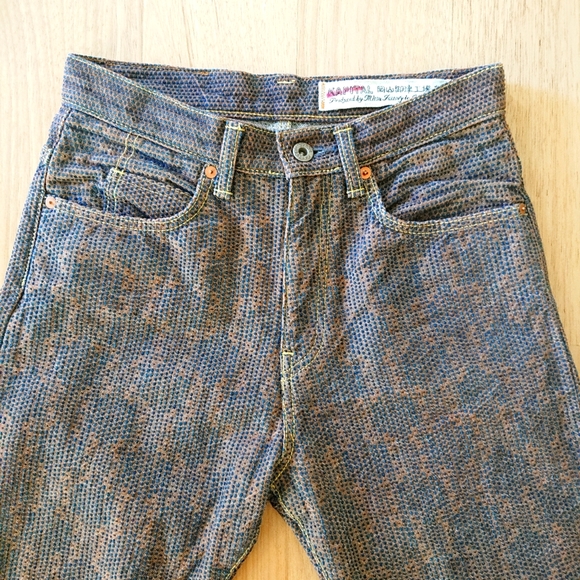
Because the dye only sits on the surface of the thread, every fold, every wash, every crease, every day of wear pulls a little more color away. The sashiko stitching wears through differently than the base weave. The warp fades faster than the weft. The garment begins to record the body that's wearing it. Knees. Hips. Wallet outlines. The way one person walks. The way another sits.
No two pairs of Century Denim age the same way. They can't.
This is also where Kapital sits inside the broader Japanese aesthetic of wabi-sabi: the idea that there's a particular kind of beauty in things that are imperfect, asymmetrical, lived-in, and unpretentious. A new pair of Century Denim is rough and uniform. A ten-year-old pair is a record. The garment becomes more itself, not less, as time moves through it.
A hundred years, in one pair
Kapital didn't invent any of the techniques inside Century Denim. The Levi's-style construction is over a century old. Sashiko stitching is older. Indigo and kakishibu and sumi dyes are older still. Some of them go back further than recorded denim itself.
What Kapital did was put them in the same room. Old Levi's hardware. Edo-period stitching. Cotton spun on machines built decades ago. A loom that runs slow on purpose. Dyes that take two years to ferment.
The result is a garment that isn't traditionally Japanese, and isn't traditionally American, and doesn't really belong to any single decade. It carries pieces of all of them.
That's the project. Not reinvention. Connection.
Some garments are designed to outlive the people who wear them. This is one of them.
The sabi journal
Stories behind the things we carry